The TRUTH about the economy and investing

The TRUTH about the economy and investing

Houston, TX · Member since 2019 · 13 posts · 4 votes

Its awkward, but it needs to be said....

The FACTS about our economy (GDP, unemployment, workforce participation, etc...) have no bearing on asset prices! 

I'm not an economist, I'm just a curious young man. There will always be money to be made in the world and I placed a premium on understanding our world if I am going to invest my money in it. It seems intimidating to learn new things for some of us, I found it is much easier to learn by listening and reading people smarter than me. 

Here is a list of influential books & people that have shaped my education. I would love to hear about yours, be safe out there!

----------------------------------------------------------------------------------------------------------------------------------------------------------

Jim Rickards- (The Road to Ruin, Aftermath)

Jim Bianco- (Bianco Research) 

Danielle DeMartino Booth- (Fed Up, Quill Intelligence)

The Zero Interest Trap   

Daniel Kahneman- (Thinking Fast and Slow) 

Jason Burack- (Wallstreet for Mainstreet)

George Gammon- (The Rebel Capitalist Show)

Krassimir Petrov

Macrovoices- (Erik Townsend)

Eurodollar University- (Jeff Snider)

Peter Schiff

Brent Johnson- (Santiago Capital)

Robert Kiyosaki!

1Reply
85 views

Most Popular Reply

Real Estate Investor · Springfield, MO · Member since 2017 · 1k+ posts · 2k+ votes
6y

@James Barry, hi and welcome to BP!

I'm going to take another view on your first assertion.  I think those factors absolutely DO have a huge bearing on asset prices.  The fact that you don't see or understand the impact yet doesn't prove your statement true.  It simply means you haven't seen or understood the impact yet.  And when I say "you", I mean "we".  NO ONE knows the full impact of the current state of affairs, and no one probably will know for at least 5 years.

Economics is a bit like history: the winners write (and sell) the books, and even then the winners disagree.  Please find me two economists that agree on much of anything, except that rent control is generally bad.  Even Paul Krugman, champion of progressive policy, agrees with that.

That's a nice reading list you've got.  A few I recognize, but most I don't.  Maybe I'll pick up a few since I have some time these days.

A word of caution: I know his name is almost like a deity on Bigger Pockets, but I simply cannot take Robert Kyosaki seriously.  Yes, I've heard 1,000 people say how he "changed their thinking" about money.  Okay, fine.  So what?  His stories are mostly fiction, his advice is mostly fluff, and his financial achievements are mostly figuring out how to sell the same finance fiction repackaged over a decade into several different books.  Some of his advice is very risky and/or illegal, like taking your family on a vacation to an exotic tropic location and writing it off as a business expense because you look at a few properties.  If you want a straight, no holds barred analysis of Kyosaki, try this.  I'm not saying Reed has the final word, but you would be wise to look at and consider his word in light of what you've read in Kyosaki's material, then judge for yourself.

https://johntreed.com/blogs/john-t-reed-s-real-estate-investment-blog/61651011-john-t-reeds-analysis-of-robert-t-kiyosakis-book-rich-dad-poor-dad-part-1

So....now you probably think I don't know what I'm talking about, and that's fine if you do.  I think you'll get far more practical, real world advice from a local CPA, real estate attorney, and investor who has actually done deals successfully for the past 20 years.  Spend your money there before reaching for high priced guru books and courses.   It will sharpen your BS detector so you will avoid paying big money to learn common sense 101 "strategies" and "secrets" packaged with a lot of hype.

Anyway, that's all I've got for now.  Good luck learning and keep reading!  But also, find some wise local investors and talk to them.  They will be valuable guides.

See this reply in the discussion

33 Replies

Jump to latestLatest
  • Real Estate Investor · Springfield, MO · Member since 2017 · 1k+ posts · 2k+ votes
    6y

    @James Barry, hi and welcome to BP!

    I'm going to take another view on your first assertion.  I think those factors absolutely DO have a huge bearing on asset prices.  The fact that you don't see or understand the impact yet doesn't prove your statement true.  It simply means you haven't seen or understood the impact yet.  And when I say "you", I mean "we".  NO ONE knows the full impact of the current state of affairs, and no one probably will know for at least 5 years.

    Economics is a bit like history: the winners write (and sell) the books, and even then the winners disagree.  Please find me two economists that agree on much of anything, except that rent control is generally bad.  Even Paul Krugman, champion of progressive policy, agrees with that.

    That's a nice reading list you've got.  A few I recognize, but most I don't.  Maybe I'll pick up a few since I have some time these days.

    A word of caution: I know his name is almost like a deity on Bigger Pockets, but I simply cannot take Robert Kyosaki seriously.  Yes, I've heard 1,000 people say how he "changed their thinking" about money.  Okay, fine.  So what?  His stories are mostly fiction, his advice is mostly fluff, and his financial achievements are mostly figuring out how to sell the same finance fiction repackaged over a decade into several different books.  Some of his advice is very risky and/or illegal, like taking your family on a vacation to an exotic tropic location and writing it off as a business expense because you look at a few properties.  If you want a straight, no holds barred analysis of Kyosaki, try this.  I'm not saying Reed has the final word, but you would be wise to look at and consider his word in light of what you've read in Kyosaki's material, then judge for yourself.

    https://johntreed.com/blogs/john-t-reed-s-real-estate-investment-blog/61651011-john-t-reeds-analysis-of-robert-t-kiyosakis-book-rich-dad-poor-dad-part-1

    So....now you probably think I don't know what I'm talking about, and that's fine if you do.  I think you'll get far more practical, real world advice from a local CPA, real estate attorney, and investor who has actually done deals successfully for the past 20 years.  Spend your money there before reaching for high priced guru books and courses.   It will sharpen your BS detector so you will avoid paying big money to learn common sense 101 "strategies" and "secrets" packaged with a lot of hype.

    Anyway, that's all I've got for now.  Good luck learning and keep reading!  But also, find some wise local investors and talk to them.  They will be valuable guides.

  • Investor · Topeka, KS · Member since 2015 · 1k+ posts · 1k+ votes
    6y

    @Erik W. I couldn't agree more on Kiyosakis.  Now there are around 2-3 ideas that I learned from his books that I find valuable and did impact how I think about money, but those could have been spelled out in 2-3 separate paragraphs rather than multiple books that rehash the same thing over and over again.

  • Joseph CacciapagliaBusiness Member
    Lender · San Antonio, TX · Member since 2020 · 1k+ posts · 1k+ votes
    6y

    Nassim Nicholas Taleb's Incerto series is a must read, if you really want to understand how the world works. If reading it doesn't change the way you operate your business and your life, then read it again. He cracks the code on "how not to be a sucker". 

    Joseph Cacciapaglia powered by Morty
  • Professional · New York City, NY · Member since 2017 · 19 posts · 5 votes
    6y


    The global economy, supply chain, and capital markets have come to a complete halt.... How will that not have a major economic impact on assets specifically real estate? 

    Commercial real estate was already grappling with some challenges before this. Obviously there are going be be major changes and challenges in office and retail especially in urban environments. But i'm sure housing will see a blip as well. I would not want to be a levered up developer with a lot of office or retail inventory on my hands. Not to mention all the stuff that's in construction, way behind schedule based on the delays and inability to get materials and manpower. But I'm a pessimist. 

  • Houston, TX · Member since 2019 · 13 posts · 4 votes
    6y

    @David Abbate

    David,

    My statement of the economy and asset prices is a critique of Capitalism’s current short comings.

    For example the 30 Million Americans unemployed are not being reflected by the prices of the DOW/SP500.

    You’re welcome to be confrontational if you wish but my post was asking about material you’ve consumed that have shaped your education.

  • Investor · Boston, MA · Member since 2015 · 1k+ posts · 3k+ votes
    6y

    @James Barry

    What exactly are you saying?

    That those factors you listed have no impact on the economy? Ok, why don't they and what other factors do? 

    Or are you saying that the overall US equities market (what I assume you mean when you say capitalism, since capitalism, being an economic system and all, isn't impacted by job lose et al. ) is not efficient at the moment? If so, fair enough, but what has lead you to this conclusion. 

    We need more than a statement and a list of books to have a meaningful discussion. What did you learn from those books, taken together with other information, caused you to arrive at your ideas? 

  • Rental Property Investor · St. Paul, MN · Member since 2016 · 3k+ posts · 3k+ votes
    6y

    I don't quite understand how the economy doesn't impact asset prices. They may not change at the exact same time and the exact same amount, but they are 100% correlated. 

  • Real Estate Agent · Cleveland, OH · Member since 2020 · 280 posts · 365 votes
    6y

    @James Barry This is quite the welcome to BP, huh?! Maybe we can take this in a little bit different direction. There are some real gems in Dale Carnegie's How to Win Friends and Influence People. It's one of those things you can go back and reference over and over again and learn something new every time. Whichever approach you take to investing or viewing the economy, I find that real estate, even more than other industries depends on your ability to connect and build trust with others. That will be my contribution to the "book list" discussion for this evening.  

    What about you? If you could only pick one of those books for someone else to read who was brand new to real estate, which one would it be (other than Robert Kiyosaki, too obvious)

    PS- there may still be time to update your original post to clarify your question :)

  • Investor · Singapore · Member since 2013 · 1k+ posts · 3k+ votes
    6y

    There is a real truth about the economy. But it's scary. At the base of it are real human needs. Maslow's hierarchy of needs is a good representation of that. But what we have built on top that is a huge complex shell game that we have no option but to continue because everyone is invested in it. Money itself is a construct that is based on perceived value. And that's true even for gold or bitcoin or any other so called store of value. We have seen what happens when faith in a currency goes away. Venezuela, Zimbabwe, Germany (post WW) etc etc. So of course all assets are also based on perceived value. This is not all bad. When it works it works. But now we have created complexities in the financial markets that nobody actually understands. So when it all comes crashing down the only resort is creating more money, which the US has been doing for decades. The world will play along because it has no choice. Wall Street is a rigged Casino but its the only game in town so everyone plays it. What happens when the music stops? Well it can't really stop because the whole world is on the ride. And this ride is only partly dependent on the real economy as long as we can create more money out of thin air. So short of total economic and social collapse where nothing will matter but guns and food and fuel, we have to play the game.

  • Peoria, IL · Member since 2013 · 967 posts · 383 votes
    6y
    Originally posted by @Joseph Cacciapaglia:

    Nassim Nicholas Taleb's Incerto series is a must read, if you really want to understand how the world works. If reading it doesn't change the way you operate your business and your life, then read it again. He cracks the code on "how not to be a sucker". 

     daang you! my reading list keeps expanding.

    if you were only gonna listen to one of his Audible books, which one? seems like reviewers either loved or hated his books. 

  • Joseph CacciapagliaBusiness Member
    Lender · San Antonio, TX · Member since 2020 · 1k+ posts · 1k+ votes
    6y
    Originally posted by @Kirk R.:
    Originally posted by @Joseph Cacciapaglia:

    Nassim Nicholas Taleb's Incerto series is a must read, if you really want to understand how the world works. If reading it doesn't change the way you operate your business and your life, then read it again. He cracks the code on "how not to be a sucker". 

     daang you! my reading list keeps expanding.

    if you were only gonna listen to one of his Audible books, which one? seems like reviewers either loved or hated his books. 

     If you have to choose just one, read Antifragile. It has the most applicable information. However, the book references a lot of information from earlier books in the series. If you're going to skip those, the reasoning for a lot of his advice might be hard to understand. 

    Joseph Cacciapaglia powered by Morty
  • Avery CarlBusiness Member
    Real Estate Agent · USA · Member since 2016 · 909 posts · 1k+ votes
    6y

    Changes in all of those factors don’t necessarily affect asset prices *immediately* but in time they do.

  • David MartinPro Member
    Cypress, TX · Member since 2016 · 137 posts · 119 votes
    6y

    @James Barry I'll agree in the smallest sense that the data does not have a specifically direct affect on the asset price, but that it has an affect on market perceptions, which then in turn affect asset prices. As a contrary point though, indirectly, it absolutely has an effect, and to deny that is wanton hubris.

  • WorldWide · Member since 2016 · 1k+ posts · 1k+ votes
    6y

    he's right, just look at the stock market run-up from March lows (fed emptying its clip didn't stop the drop and ridiculous economic indicators have not stopped this run-up (S&P rallied on days that showed huge unemployment #s...) ). We got back within 13% of the S&P February top based on what? lol 

  • David MartinPro Member
    Cypress, TX · Member since 2016 · 137 posts · 119 votes
    6y

    @Victor S. Market prop up is because the fed hasn't stopped emptying it's clip. It's just reloading over and over in the public eye, and then on the side is back funding about 5x what doesn't show up in the news as stimulus for .Gov.

  • Member since 2019 · 111 posts · 130 votes
    6y

    @James Barry

    You begin with a bold statement that can't agree with until I understand your definition of "facts" and "assets"

    I have read many of the books on your list but below are a few that were missing (but that affected my thinking):

    Dennis Peacocke   (On the Destiny of Nations,  The Battle for the Minds of Men)

    Johnathan Eisen  (Suppressed Inventions and other Discoveries)

    The Richest man in Babylon (Clayson)

    Strengthsfinder 2.0 Tom Rath

    The Millionaire Next Door  Thomas Stanley

    Freakanomics Leavitt and Dubner

    Forgive the typos,   I can add more when I get back from work.

  • Investor · Boston, MA · Member since 2015 · 1k+ posts · 3k+ votes
    6y
    Originally posted by @Victor S.:

    he's right, just look at the stock market run-up from March lows (fed emptying its clip didn't stop the drop and ridiculous economic indicators have not stopped this run-up (S&P rallied on days that showed huge unemployment #s...) ). We got back within 13% of the S&P February top based on what? lol 

     Not trying to get into a monetary policy debate, but since markets are forward looking, it isn't odd that they don't respond all the time with 1:1 correlation to news. When the market rose the day April's unemployment announcements were made, one explanation is the numbers were not as bad as the majority of participants had thought. 

  • WorldWide · Member since 2016 · 1k+ posts · 1k+ votes
    6y
    Originally posted by @Bill F.:
    Originally posted by @Victor S.:

    he's right, just look at the stock market run-up from March lows (fed emptying its clip didn't stop the drop and ridiculous economic indicators have not stopped this run-up (S&P rallied on days that showed huge unemployment #s...) ). We got back within 13% of the S&P February top based on what? lol 

     Not trying to get into a monetary policy debate, but since markets are forward looking, it isn't odd that they don't respond all the time with 1:1 correlation to news. When the market rose the day April's unemployment announcements were made, one explanation is the numbers were not as bad as the majority of participants had thought. 

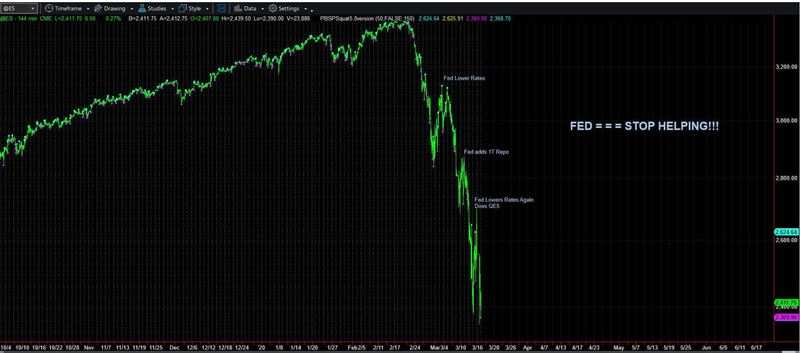
    Not as bad? It was terrible! lol There is really no reason for us to be only 15% off the top on S&P (Nasdaq stuff got even closer).

    Check this graphic, re: Fed's helping hand


    picture comes up too small on BP. full one here: 

    https://seekingalpha.com/article/4332374-sentiment-speaks-fed-please-stop-helping

  • Flipper/Rehabber · Cleveland, OH · Member since 2014 · 173 posts · 121 votes
    6y

    @James Barry

    I’m a macrovoices addict and I also love studying how money works ( ie fractional reserve Banking, what is money etc, how is a dollar created, Breton woods agreement)

    I agree with the things you said may not matter as much as people think. Ultimately the things that impact asset prices that can over ride what the free market pay for is

    - monitory policy

    - government/private sector credit expansion

    - fiscal policy

    - Interest rates set by (a private) federal reserve

    - then finally the consumer ( which is probably influenced by the three prior)

    - Investor/Consumer confidence

  • JD MartinBusiness Member
    Moderator
    Rock Star Extraordinaire · Northeast, TN · Member since 2015 · 10k+ posts · 16k+ votes
    6y

    No way to discount Kiyosaki's Rich Dad/Poor Dad from the list of influential stuff. By far the most cited book on the BP podcast. I never read it until well into my investing, but then I did read it to see what the ado was about. It was entertaining, not much in it for me BUT I can see how it would be massively influential on someone who was just picking this stuff up. Kind of like Richest Man in Babylon, which was also entertaining and not a lot of use if you get these concepts but to get someone ramped up absolutely great.

    Lately Kiyosaki has gone off the deep end. I think he should quit doing his podcast because he is going to destroy his reputation with some of the kooky stuff he's saying these days. I finally had to just quit listening to it. He reminds me of my departed step-grandfather, who always had a little weird bend to him but started really subscribing to some crazy conspiracy theories once he got up there past 70.

    At the risk of making a lot of people mad, I'm going to say it anyway - economics is kind of a junk science. It's barely science anyway, since it depends almost completely on the whims, actions and reactions of humans, a species that acts quite irrationally most of the time and cannot be trusted to act irrationally in the same fashion most of the time. Science - real science - depends on theories and experiments that can corroborate and confirm a large body of evidence to create "facts", generally replicable. Economics depends on studies of past human actions/reactions to formulate models of action to predict future events, which then largely fall on their face as humans screw up the model by doing what they do best - act irrationally. Every economist is an expert at past events. It's not hard to be an expert historian when discussing the Battle of Gettysburg or D-Day. Try being an expert at future history! 

    One book that was mentioned on here is really pertinent to all this stuff - AntiFragile, which is a great example of how the idea of economic (and other kinds of preparedness) are largely insufficient because the modeling sucks. 

    Skyline Properties
    View Page
  • Rental Property Investor · Fishers, IN · Member since 2016 · 337 posts · 470 votes
    6y

    This is not the first time in history where assets prices do not relate to what assets are actually worth.  Pandemic aside, this is quite normal, economically.  It seems you like books....read "The Intelligent Investor" by Benjamin Graham.  Warren Buffets mentor.  Some of the info is data, but most is timeless.  Market cycles are somewhat predicable, even though the cause is not.  Understand the economics, how markets work, and how real estate fits in, and then know how to balance your risk tolerance and knowledge to capitalize. 

  • Investor · Boston, MA · Member since 2015 · 1k+ posts · 3k+ votes
    6y
    Originally posted by @Victor S.:
    Originally posted by @Bill F.:
    Originally posted by @Victor S.:

    he's right, just look at the stock market run-up from March lows (fed emptying its clip didn't stop the drop and ridiculous economic indicators have not stopped this run-up (S&P rallied on days that showed huge unemployment #s...) ). We got back within 13% of the S&P February top based on what? lol 

     Not trying to get into a monetary policy debate, but since markets are forward looking, it isn't odd that they don't respond all the time with 1:1 correlation to news. When the market rose the day April's unemployment announcements were made, one explanation is the numbers were not as bad as the majority of participants had thought. 

    Not as bad? It was terrible! lol There is really no reason for us to be only 15% off the top on S&P (Nasdaq stuff got even closer).

    Check this graphic, re: Fed's helping hand


    picture comes up too small on BP. full one here: 

    https://seekingalpha.com/article/4332374-sentiment-speaks-fed-please-stop-helping

    Like I said Victor, I'm not trying to get into debate about monetary policy. You and I have different views on this and I don't know nearly enough macro economics to have a productive discussion. 

    My only point was that in absolute terms, yes the unemployment numbers were bad, very bad; however, in relative terms if the market, being forward looking, expected 5m new filings and they got 3.3m, that is relativity, not so bad and thus its not surprising that the market views this as good news. 

  • Rental Property Investor · Woodstock, GA · Member since 2017 · 517 posts · 772 votes
    6y

    The value of assets isn't related to any economic news...

    The value hedges on one thing...

    Is there cash coming in or going out of the market? 

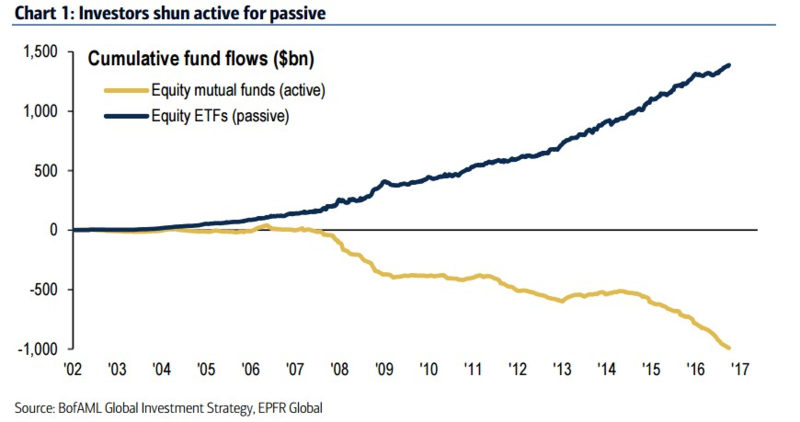
    I mentioned this on a FB post inside BP's group...right now, we're in the middle of a massive passive investing bubble. 

    Money has been pouring into the markets passively and not actively moving in and out of assets. 

    In other words, "Dollar-cost averaging" as all the quack financial gurus like Suzy Orman recommend and millions upon millions of Americans listen to. 

    What this means is that people go "I'm just going to invest $100 per month. I don't care where the market is. I don't care if it's up or down. I'm 'hedging my risk' like a pro."

    What this does is it destroys "price discovery." Price discovery is an investment strategy of finding assets that are undervalued. 

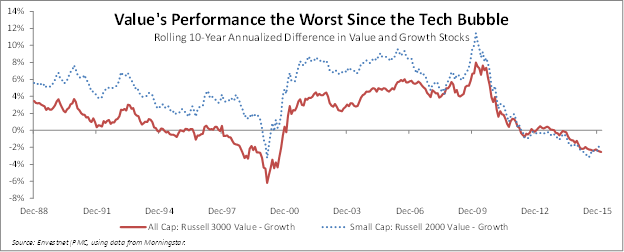
    That's why "value investing" is performing the worst ever in history right now. 

    Thus, it means value and assets haven't been tied for a long time. 

    As long as cash continues to flow into assets, prices will rise over time. 

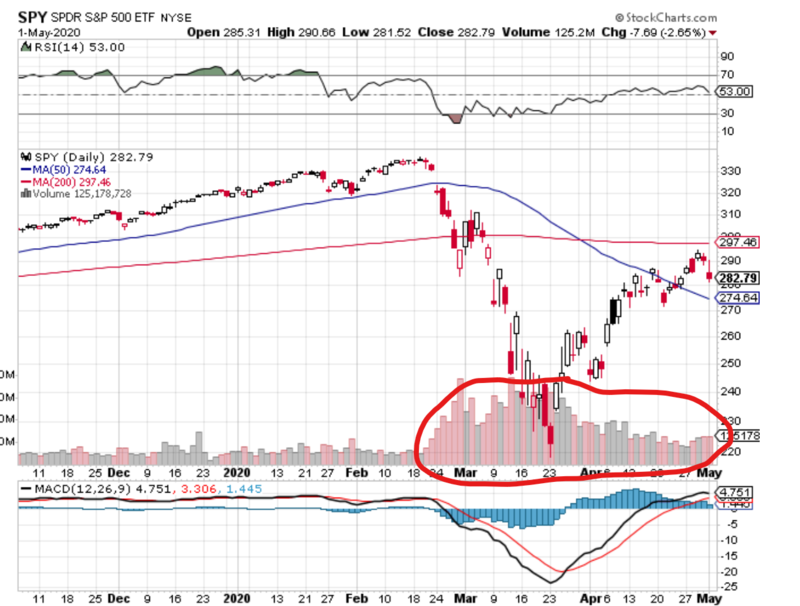
    Right now, volume in the stock market (for instance) is DOUBLE what it was before the coronavirus. 

    This means more transactions are taking place...on "up days" there is more volume signaling that there is strength. 

    The question is "Where is this money coming from?" as the savings rate in America is at its highest since 1981. 

    Well...

    We have: The Federal Reserve flooding the market, shorts covering their position, beginner investors jumping in ( I have multiple family members asking me about stocks and they've never invested before...i.e. what it was like in 2017 and Bitcoin...)

    ----

    What will it take for things to crash? 

    A chain reaction of selling as the trading algorithms feed into each other (why markets fall faster than they rise). 

    Many of the wealthiest --- including and especially Warren Buffett, Apple --- are still sitting on billions in cash. 

    Meaning...they feel that trigger event hasn't happened yet. 

    But it will. 

    When? 

    I'd estimate we'll see the next major drop in the fall...as that's when most major drops happen. (sept - oct). 

    ****
    In the meantime, check out stuff by RealVision. 

    https://www.youtube.com/watch?v=TMkx8OZMd_0

    I'm a bit biased as they used to be a marketing client of mine, but they produce some high value stuff.

  • Investor · Boston, MA · Member since 2015 · 1k+ posts · 3k+ votes
    6y

    @Joe Cassandra

    Curious what you would need to see change to alter your opinion that a crash is coming?

  • Matthew Irish-JonesBusiness Member
    Real Estate Agent · Buffalo, NY · Member since 2017 · 2k+ posts · 2k+ votes
    6y

    @James Barry everything in an economy has a ripple effect. Real estate in a lot of ways is a lagging indicator. A weak economy will eventually have an impact on Asset values.

    Irish Jones Realty4.947 Reviews
    View Page
Join the conversationCreate a free account to reply, vote on answers and follow this thread.