PGH2O water/sewage bills - landlord's responsibility or tenant's?

PGH2O water/sewage bills - landlord's responsibility or tenant's?

Rental Property Investor · Pittsburgh, PA · Member since 2019 · 38 posts · 13 votes

I have a SFH property here in Pittsburgh that will be finished with work and ready for rent in the next few weeks, and I'm wondering about the water bill (PGH2O to be specific). First off, I also own a duplex which doesn't have the water split between units, so it is in MY name as the landlord and I pay the water/sewage bill each month for both units, while the tenants each pay for their own gas/electric - this seems pretty standard around here. However, with the new single family rental, my initial thought was that the incoming tenant would pay for ALL utilities. While I've seen plenty of similar rentals with ALL utilities paid by the tenant, I also see a few that keep the water in the landlord's name (tenant is NOT responsible, barring excessive usage).

So I'm wondering what the reason for this is, whereas the electric and gas always seem to be paid by the tenant. Are there benefits to keeping the water in my name? Or should I let the tenant pay for it, along with gas/electric? That is how I'd prefer to do things, but there has to be a reason that so many rentals have water bills kept in the landlord's name.


Any and all input would be much appreciated!

0Reply
155 views

Most Popular Reply

Gibsonia, PA · Member since 2016 · 104 posts · 31 votes
5y

I think the reason property owners put the water in their name is b/c water is lien-able.  In other words, if the water is in your tenants name and they don't pay the water for 6/9/12 months, when they move out and you go to sell the place at some point, there is going to be a lien against the property and then you'll be responsible for settling that debt.  So you can keep it in your name and just send the bill to the tenant each month.  I use property management and the bill goes directly to my PM who then bills the tenant.

See this reply in the discussion

13 Replies

Jump to latestLatest
  • Specialist · Charlotte, NC · Member since 2021 · 185 posts · 106 votes
    5y

    I work for a property management company in Charlotte NC.  The tenant is responsible for the water bill.  The tenant is actually responsible for all utilities.  Hope that helps!

  • Gibsonia, PA · Member since 2016 · 104 posts · 31 votes
    5y

    I think the reason property owners put the water in their name is b/c water is lien-able.  In other words, if the water is in your tenants name and they don't pay the water for 6/9/12 months, when they move out and you go to sell the place at some point, there is going to be a lien against the property and then you'll be responsible for settling that debt.  So you can keep it in your name and just send the bill to the tenant each month.  I use property management and the bill goes directly to my PM who then bills the tenant.

  • Handyman · Pittsburgh, PA · Member since 2018 · 5k+ posts · 13k+ votes
    5y

    Answering you over in the other forum, but @Chris Policicchio is giving you the right answer. I've been on the wrong end of more than one of those liens. And it's different in each municipality. Pittsburgh Water and Sewage are together, but some other municipalities turn the water bill over to private companies and keep the sewage bill in-house, or with yet another private company. In any case, it's always the sewage that is lienable.

    This can often be used to your advantage when researching properties because all you have to do is ask any tenant here who pays their sewage bill and you have a pretty good idea of how many times the landlord's been around the block.

  • Rental Property Investor · Pittsburgh, PA · Member since 2019 · 38 posts · 13 votes
    5y
    Originally posted by @Jim K.:

    Answering you over in the other forum, but @Chris Policicchio is giving you the right answer. I've been on the wrong end of more than one of those liens. And it's different in each municipality. Pittsburgh Water and Sewage are together, but some other municipalities turn the water bill over to private companies and keep the sewage bill in-house, or with yet another private company. In any case, it's always the sewage that is lienable.

    This can often be used to your advantage when researching properties because all you have to do is ask any tenant here who pays their sewage bill and you have a pretty good idea of how many times the landlord's been around the block.

    Thanks to everyone for the solid insight. And to your question in the other forum (unsure of how to delete that other post), this house is in Mt. Washington // city of PGH. I don't plan to sell it anytime soon, but I guess those are certainly good reasons to keep it in my name...

  • Specialist · Charlotte, NC · Member since 2021 · 185 posts · 106 votes
    5y

    It must work differently here.  If you are late paying your water bill the city comes and shuts it off.

  • Handyman · Pittsburgh, PA · Member since 2018 · 5k+ posts · 13k+ votes
    5y
    Originally posted by @Robert Kohnfelder:
    Originally posted by @Jim K.:

    Answering you over in the other forum, but @Chris Policicchio is giving you the right answer. I've been on the wrong end of more than one of those liens. And it's different in each municipality. Pittsburgh Water and Sewage are together, but some other municipalities turn the water bill over to private companies and keep the sewage bill in-house, or with yet another private company. In any case, it's always the sewage that is lienable.

    This can often be used to your advantage when researching properties because all you have to do is ask any tenant here who pays their sewage bill and you have a pretty good idea of how many times the landlord's been around the block.

    Thanks to everyone for the solid insight. And to your question in the other forum (unsure of how to delete that other post), this house is in Mt. Washington // city of PGH. I don't plan to sell it anytime soon, but I guess those are certainly good reasons to keep it in my name...

    Yeah, you have to, especially with City properties. So imagine you've running 12 C-class properties and working on your next deal, and one of your tenants stops paying the water bill, and the municipality quietly puts a lien on the property. That gets picked up by the credit agencies and your 700+ credit score takes a nosedive. Financing falls through and you're totally screwed on the deal, you can't pay back the money you took out of your IRA to buy this place initially for cash, you get to pay the penalty and the tax.

    It turns into a cascading event and you're busted out of the buy-and-hold business.

    Do you want to give a tenant that kind of power over you?

  • Handyman · Pittsburgh, PA · Member since 2018 · 5k+ posts · 13k+ votes
    5y
    Originally posted by @Amy Shutes:

    It must work differently here.  If you are late paying your water bill the city comes and shuts it off.

    Yes. Pittsburgh is fundamentally a funhouse mirror of an American city. That's the starting principle you have to work from here.

  • Anthony KingPro Member
    Investor · Charlotte, NC · Member since 2020 · 239 posts · 247 votes
    5y

    @Jim K. Funhouse mirror of an American city? Curious what that means. Anyway, I live and own SFR's in Pittsburgh and OOS. The water on my SFR's are always paid by the tenant. I learned years ago to call the water department at the end of their fiscal year to make sure the bills are current. I've never had them not be paid, but if they were overdue I would be reaponsible in the manner others have mentioned. If you like paying $100+ a month to not worry about then go ahead. I make 1 phone call a year about it and sleep well at night.

  • Handyman · Pittsburgh, PA · Member since 2018 · 5k+ posts · 13k+ votes
    5y
    Originally posted by @Anthony King:

    @Jim K. Funhouse mirror of an American city? Curious what that means. 

    How anyone can argue that Pittsburgh isn't the oddest place in America is beyond me. I am of the opinion, of course, that being original is not a particularly bad thing, but hey, to each his own. All the following are true about Pittsburgh:

    1. 446 bridges. More bridges than any other city in America. More bridges than in Venice. I didn't understand how weird this was until I WENT to Venice and found myself standing on the Rialto Bridge saying, "Mehh, big deal."

    2. There's a "West Mifflin" and no "East Mifflin." Do you know why? The borough was originally called just "Mifflin" and then a one-horse town in the middle of Pennsylvania wanted the name, so they renamed Mifflin West Mifflin and that was that.

     3. McKeesport and McKees Rocks are named after two different McKees who were probably not related. I mean, really? Like the extended McKees family are just coming out of the woodwork anywhere else?

    4. Last but not least at all, please consider the singular craziness of the following: there are a full 130 municipalities in Allegheny County. Three of those municipalities are named as follows:  The Borough of Versailles, North Versailles Township, South Versailles Township. Set aside the fact that "Versailles" in the three names is pronounced "Verr-SALES." There is no common border between ANY of these three municipalities: each one is geographically segregated from the other two. How gloriously weird is that???

    Honorable mention: In English the singular of the second person is the archaic "thee/thou." "You" is the plural form. Pittsburgh is the one place in America where a distinctive plural of "you," not the simply illiterate "yous" or "y'all" exists. What is not well understood (even in Pittsburgh) is that this plural originated in the Scotch-Irish immigrant pronunciation of English of the 1700s as a contraction of "you ones." I am speaking, of course, of "yinz." Because it is also not well understood that the entire America accent as we understand it ORIGINATED HERE in Yinzerburgh.

    Honorable mention 2: Where else do locals get in fistfights with out-of-towners over an orthographic final H?

    Ok, honorable mention 3: Yellow is yellow and gold is gold, except, of course, here, where people actually say they "bleed black and gold."


  • Pittsburgh, PA · Member since 2015 · 52 posts · 26 votes
    5y

    @Jim K.,

    I hope you get this reference:


    Great 1, 2, 3, and honorable mentions.

    I completely agree that there are many quirky goings-on in the Burgh’. As a forced transplant myself (wife’s family is from here, so naturally we moved back) I find myself as an outsider looking in many facets of live here.

    One thing is for certain...I always find myself scratching my head asking, “Really?”

    Dave
  • Rental Property Investor · Indianapolis, IN · Member since 2020 · 562 posts · 554 votes
    5y

    @Robert Kohnfelder

    I alway put it in my lease that tenant pays all utilities. Period.

  • Real Estate Agent · Pittsburgh, PA · Member since 2015 · 1k+ posts · 846 votes
    5y
    Originally posted by @Robert Kohnfelder:

    I have a SFH property here in Pittsburgh that will be finished with work and ready for rent in the next few weeks, and I'm wondering about the water bill (PGH2O to be specific). First off, I also own a duplex which doesn't have the water split between units, so it is in MY name as the landlord and I pay the water/sewage bill each month for both units, while the tenants each pay for their own gas/electric - this seems pretty standard around here. However, with the new single family rental, my initial thought was that the incoming tenant would pay for ALL utilities. While I've seen plenty of similar rentals with ALL utilities paid by the tenant, I also see a few that keep the water in the landlord's name (tenant is NOT responsible, barring excessive usage).

    So I'm wondering what the reason for this is, whereas the electric and gas always seem to be paid by the tenant. Are there benefits to keeping the water in my name? Or should I let the tenant pay for it, along with gas/electric? That is how I'd prefer to do things, but there has to be a reason that so many rentals have water bills kept in the landlord's name.


    Any and all input would be much appreciated!

     Usually the owner pays water and sewer and bills back the tenant. This is because if it's unpaid they can put a lien on the house. 

  • Nathan GesnerBusiness Member
    Moderator
    Real Estate Broker · Cody, WY · Member since 2010 · 28k+ posts · 41k+ votes
    5y

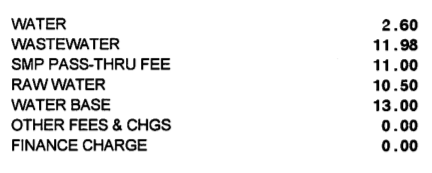
    This is a real water bill from March of this year on a duplex. Total charges: $49.08 but the majority of it is base fees that never fluctuate. The actual water use is just $2.60

    If you had two separate meters, each tenant would be paying all those base fees of $46.48 and then their actual water use. By splitting the one water meter, you're effectively cutting their water bill in half.

    Here's what I do. Contact the utility provider and ask for an average over the past year.  Let's say it comes to $25 each. Bump it 10% to handle excess use and now you're at $27.50 per renter. Add it to their rent and your work is done.

    You may also consider a cap on what's included. Anything above that will be passed on to the renter. For example, I had a shared meter with four units. One of the tenants started a little garden and accidentally left he hose running for the weekend before it was caught. We got a bill 4x the normal amount so I found out who was responsible and charged them for it. If you can't determine who's responsible, split it.

    The DIY Landlord Book4.7247 Reviews
Join the conversationCreate a free account to reply, vote on answers and follow this thread.