Hope you’re all doing well and making strides toward your financial goals!
I’m at the starting line of my real estate and financial freedom journey. I own a home in the San Fernando Valley and recently pulled a $200K HELOC for investment purposes. But to be honest, I’ve hit some roadblocks and lost momentum—procrastination, high interest rates, soaring home prices, and low inventory, blah, blah, blah.. lol—have all played a role.
I’ve been using Redfin, Zillow, Trulia, and Realtor.com to search, and I recently discovered BiggerPockets after attending a local realtor event. My goal with this post is to connect with experienced investors and professionals who can share insights, strategies, and opportunities to help me take the next step.
I’m currently looking at Southern California, Arizona, and Texas (Houston & Dallas) with a target of 8-10% ROI. But I’ll admit, I’m hesitant about out-of-state investing since I’m unfamiliar with rental markets in those areas. Being a dad of 3, a soccer coach, working a full-time job, and being a full-time student can make getting away a little challenging. For those of you in SoCal, you know how tough this market is!
I’d love to hear your thoughts—any advice, encouragement, or knowledge drops that can help me get the ball rolling would be greatly appreciated
Hey Jay—appreciate the transparency here. Balancing work, family, school, and trying to get into real estate is no small feat, especially in SoCal where finding cash flow is like searching for a unicorn.
You’re already ahead of the game just by lining up capital and doing the research. That said, I’ve been down a similar road—working full-time, raising a family, and slowly building a portfolio across three states. What helped me break through was:
– Focusing on one market and building a local team before chasing the next “hot” area. Out-of-state investing works, but only if you treat it like a business and plan for the extra friction.
– Getting real about my actual time availability—I had to choose systems and partners that didn’t rely on me being hands-on.
– Being patient with capital deployment. A $200K HELOC is powerful, but it's also a trap if you rush. Wait for the deal that fits your model—not someone else’s.
I now spend part of my time helping others navigate the same challenges, especially when it comes to out-of-state investing and avoiding some of the early mistakes I made. Feel free to DM me—happy to share some resources and what’s worked for me.
It sounds like you're considering purchasing with 100% borrowed funds - is that accurate?
I would not do that - it will be just about impossible to make money after servicing all that debt. You can't pretend the HELOC draws are cash - they aren't. That interest has to be paid.
And, the market is just tough right now, and unfortunately I don't have a slam dunk option for you. I don't think it would make sense to buy a random property in AZ or TX just to "do a deal"... and then lose money on it every month. The forums are full of posts from investors - especially CA investors - who did exactly that.
Sorry of this comes off as discouraging - just trying to be realistic.
Hey Jay—appreciate the transparency here. Balancing work, family, school, and trying to get into real estate is no small feat, especially in SoCal where finding cash flow is like searching for a unicorn.
You’re already ahead of the game just by lining up capital and doing the research. That said, I’ve been down a similar road—working full-time, raising a family, and slowly building a portfolio across three states. What helped me break through was:
– Focusing on one market and building a local team before chasing the next “hot” area. Out-of-state investing works, but only if you treat it like a business and plan for the extra friction.
– Getting real about my actual time availability—I had to choose systems and partners that didn’t rely on me being hands-on.
– Being patient with capital deployment. A $200K HELOC is powerful, but it's also a trap if you rush. Wait for the deal that fits your model—not someone else’s.
I now spend part of my time helping others navigate the same challenges, especially when it comes to out-of-state investing and avoiding some of the early mistakes I made. Feel free to DM me—happy to share some resources and what’s worked for me.
We can be a resource for you, as we are in 52 markets in 26 states. The markets you mentioned we have a brokerage and property management presence. So essentially, I can get you in touch with professionals in each market. I'll send you a DM .
I'm an investor and agent myself here in Phoenix. I'd be happy to give you some insight into the types of strategies working in this market and the returns you can expect.
As a 2x house hacker in LA and out of state investor, here are some things to consider:
1. Be careful with these posts because that's when all the Realtors come out of nowhere saying their market is best. Take it with a grain of salt.
2. Have you considered house hacking? Something with an ADU where your family stays in the main house. That's what we are doing (I used a HELOC on my first house hack to buy the next one). Then your current residence becomes the rental. Maybe the numbers work better. Then if you move again now you have three units in a high appreciating market.
3. Does it make sense to use the $200K to convert your garage into an ADU? Typically I'm seeing $125K-$150K for a garage conversion. Even if you bought out of state, the results on your ADU might be better (lower vacancy, if self managed you now save an average of 15%-18% on property management between all their fees, etc.). I know it is for me and I invest in four different states.
4. Texas is becoming an increasing difficult market to invest in because of all the new construction. You might buy a fourplex but there is a brand new apartment building with loads of amenities that you are competing against. The only way you can compete is on price. Plus Texas has high property taxes. And before anyone says, "yea but there's no state income tax" I could make an argument that who cares because you get tax write offs anyways, versus you have to pay those property taxes regardless. I'm not saying don't invest there. I'm saying you have to do an extra layer of due diligence. I don't know if Arizona is in the same boat.
5. You are busy and you really need to factor in your time. Does it make sense to learn about different markets versus investing in your own backyard? Does it make sense to self manage locally or have a property manager do it? There are a lot of moving parts that you need to consider.
Recommend you first figure out the property Class you want to invest in, THEN figure out the corresponding location to invest in.
Why is Property Class so important for investors to understand and apply in their investing strategies?
Because the Property Class dictates the Class of the tenant pool that the property will attract.
The Tenant Class
greatly impacts rental income stability and property maintenance/damage by tenants.
Both Property Class
and Tenant Class affect what type of contractors, handymen and property management companies will work on a property.
If you buy & renovate a property in Class D area to Class A standards, what Tenant Class will rent it?
Or, if you put several Class D tenants in a Class A four-plex, what do you think will happen to the property?
So, if you fail to apply the correct assumptions to a property, your expectations won’t be met and it may even be a financial disaster.
We use the following to rank Property Classes, in order of importance:
Property Tenant Pool: closely linked to location, but not always.
Property Location: closely linked to tenant pool, but not always.
Property Condition & Amenities: it’s important to, “Maintain to the Neighborhood.”
Key metrics for each Property Class:
Class A Properties: Tenant Pool: Majority of FICO scores 680+, no convictions/evictions in last 7 years. Tenant Default: 0-5% probability of eviction or early lease termination. Section 8: Class A rents are too high and won’t be approved. Vacancies: 5-10%, depending on market conditions. Cashflow vs Appreciation: Typically, 3-5 years for positive cashflow, but you get highest relative rent & value appreciation.
Class B Properties: Tenant Pool: Majority of FICO scores 620-680, some blemishes, no convictions/evictions in last 5 years.
Tenant Default: 5-10% probability of eviction or early lease termination.
Vacancies: 10-15%, depending on market conditions. Cashflow vs Appreciation: Typically, 1-3 years for positive cashflow, balanced amounts of relative rent & value appreciation. Section 8: Class B rents are usually too high for the Section 8 program.
Class CProperties: Tenant Pool: Majority of FICO scores 560-620, many blemishes, but should have no convictions/evictions in last 3 years. Verifying recent 2-years of rental history very important! Same for 2-years of job/income stability. Tenant Default: 10-20% probability of eviction or early lease termination. Section 8: Class C rents usually meet program requirements, proper screening still recommended. Vacancies: 10-20%, depending on market conditions and tenant screening. Cashflow vs Appreciation: Should cashflow immediately, at the lower end of relative rent & value appreciation.
Class DProperties: Tenant Pool: Majority of FICO scores under 560, little to no good tradelines, lots of collections & chargeoffs, but should have no convictions/evictions in last 12 months. Verifying last 2-years of rental history and income/employment extremely important to find the “best of the worst”. Tenant Default: 20-30% probability of eviction or early lease termination.
Section 8: Class D rents meet program requirements, often challenges to pass Section 8 inspection. Vacancies: 20%+, depending on market conditions and tenant screening. Cashflow vs Appreciation: Typically, all cashflow with little, maybe even negative, relative rent & value appreciation.
Where did we get our FICO credit score information from?
Hope you’re all doing well and making strides toward your financial goals!
I’m at the starting line of my real estate and financial freedom journey. I own a home in the San Fernando Valley and recently pulled a $200K HELOC for investment purposes. But to be honest, I’ve hit some roadblocks and lost momentum—procrastination, high interest rates, soaring home prices, and low inventory, blah, blah, blah.. lol—have all played a role.
I’ve been using Redfin, Zillow, Trulia, and Realtor.com to search, and I recently discovered BiggerPockets after attending a local realtor event. My goal with this post is to connect with experienced investors and professionals who can share insights, strategies, and opportunities to help me take the next step.
I’m currently looking at Southern California, Arizona, and Texas (Houston & Dallas) with a target of 8-10% ROI. But I’ll admit, I’m hesitant about out-of-state investing since I’m unfamiliar with rental markets in those areas. Being a dad of 3, a soccer coach, working a full-time job, and being a full-time student can make getting away a little challenging. For those of you in SoCal, you know how tough this market is!
I’d love to hear your thoughts—any advice, encouragement, or knowledge drops that can help me get the ball rolling would be greatly appreciated
Hey Jay. Welcome to BiggerPockets. Great place to learn and network with other investors! Make sure you're doing plenty of market research. Figure out what market works best for you and what your overall strategy is.
I'm originally from San Francisco and ended up investing out of state back in 2021 and have been pretty happy with my decision. So much so, that I ended up moving to the market to focus on building my portfolio.
When it comes to your deal source, you might want to look into some off-market solutions. While you're at the networking events, make sure you ask about how others are sourcing your deals. Investor focused agents will be a great way to start, especially the ones who are investors themselves.
Ultimately, you're going to have to jump in all the way and buy a property in order to get started, otherwise you'll stay stuck in the same place the whole time. If you find a deal that works, go for it and dive in. You'll learn a lot just by doing that.
OOS Investing will require you to get the right teams in place (Deal finder / property manager / lender / contractors). Most property managers will already have contractor contacts that should be able to get everything done for you.
Happy to share some out of state investing experiences. Good luck on your journey!
First off, props for taking action with that HELOC—having $200K ready to invest puts you in a strong position. I get the hesitation with out-of-state investing, but if cash flow and an 8-10% ROI are your targets, markets like Memphis might be worth considering. Housing is still affordable, and with major employers like FedEx and St. Jude driving rental demand, investors here are seeing solid returns. I know time is tight with work, school, and family, so the key is having a reliable team in place to handle everything—from finding deals to managing tenants. If you're open to exploring options outside of SoCal, I'd be happy to chat and help you strategize. You've already taken big steps—now it's just about finding the right market and making that first move!
You brought up some good points, which I will try to answer.
Location, The Most Important Investment Decision
Live where you like, but invest where you can achieve lifelong financial independence.
The investment city is crucial since it determines your long-term income performance. To achieve lifelong financial independence, a location must meet several specific requirements.
Rents must grow faster than inflation to ensure your income keeps up with rising costs.
Financial independence depends on how the property will perform over your lifetime. ROI and cash flow merely estimate how a property might perform under ideal conditions on the first day of ownership. While 8-10% ROI on day-one is desirable, it's not feasible with today's high interest rates.
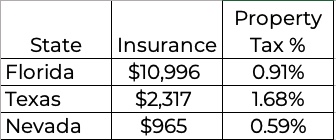
Low operating costs. Every dollar lost to overhead means less money for you. Different locations have significantly different operating costs. Below I will compare Texas, Nevada and Florida.
Low risk of natural disasters. Natural disasters can destroy communities, leaving you with a vacant property even after the insurance company rebuilds your property. People immediately move away from devastated areas and may never return because local jobs and infrastructure were also destroyed.
Pro-landlord regulations. In many locations, evicting a non-paying tenant can take many months or even more than one year. While this scenario may seem unlikely, experiencing it can be financially devastating.
Limited urban sprawl. Urban sprawl occurs when cities continuously expand into nearby countryside. New homes in these areas attract more buyers than older homes in established neighborhoods, resulting in existing home prices and rents increasing more slowly. Over time, this situation gets worse. You can see this in many big cities, where once-highly desirable neighborhoods have become run-down areas with high crime rates.
Operating Cost Comparison
As I mentioned, operating costs vary tremendously by state. Below is a comparison between Nevada, Texas, and Florida.
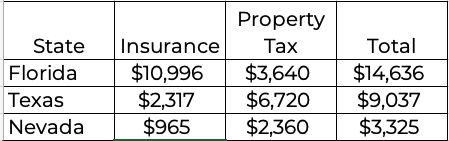
To put this in perspective, below is the estimated annual operating costs for a $400,000 property.
Compared to a property in Nevada, properties in other states require additional cash flow to compensate for their higher operating costs.
Florida: +$11,311 ($14,636 - $3,325)
Texas: +$5,712 ($9,037 - $3,325)
The takeaway is that operating costs can have a huge impact on financial independence.
Investment Team
Most investors don't live in a city that meets all the financial independence requirements, so remote investing is necessary. However, whether you invest where you live or across the country, you need to work with an experienced investment team.
The problem is that podcasts, books, seminars, and websites only provide general information. You won't be buying a general property in a general location. Instead, you'll be buying a specific property, in a specific location, in a specific condition that attracts a specific tenant segment. And, you will need a wide range of services and expertise. These are only available from a local investment team.
If you are interested, I can provide a process for finding and validating an investment team.
Summary
Choose an investment city that meets all the requirements I listed.
No matter where you invest, work with an experienced investment team. They will provide a master class in real-world investing.