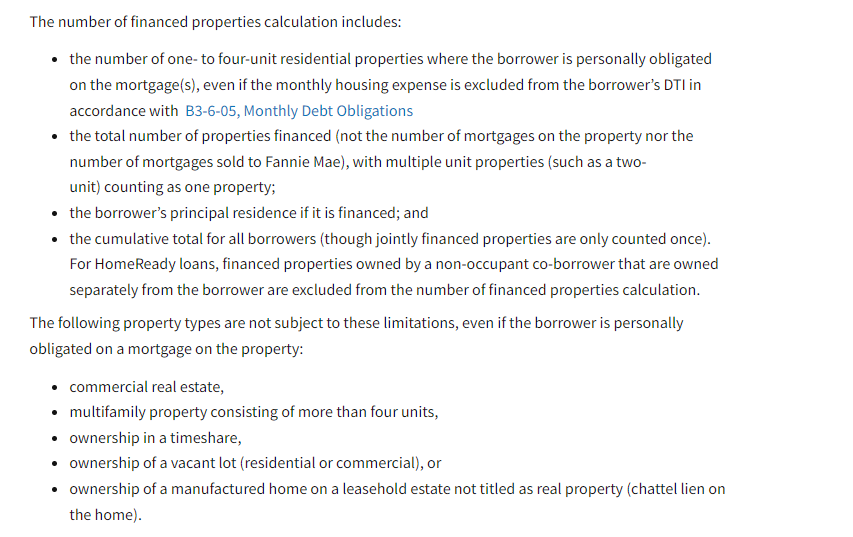
I have several duplexes that are financed with conventional 30 year Fannie/Freddie investment loans, but I have reached my limit (10). I am wondering how to proceed to acquire more properties. When I talk to my local bank, the options appear to be only a commercial loan with relatively high interest (currently 8.5-10%), 75% LTV max and maximum amortization of 20 years. When factoring in the rate and term, almost every single deal I look at is a looser due to debt service (unless the LTV is something like 50%). I believe the primary issue is the 20 year term on a typical commercial loan.
My current focus is on buying and hold duplex properties, and around me that put the total acquisition costs around $200-250k, with total monthly rents being 1.0-1.3% of the purchase price. I have also looked into small apartments 4-10 units, but found they have an even harder time to cash flow with current rates.
While I understand that current CAP rates have not necessarily adjusted to the new interest rates, which might be some of the issues. I am wondering how others have continued to finance purchases beyond the 10 Fannie/Freddie loans (that have very nice rates and 30 year terms).
I have several duplexes that are financed with conventional 30 year Fannie/Freddie investment loans, but I have reached my limit (10). I am wondering how to proceed to acquire more properties. When I talk to my local bank, the options appear to be only a commercial loan with relatively high interest (currently 8.5-10%), 75% LTV max and maximum amortization of 20 years. When factoring in the rate and term, almost every single deal I look at is a looser due to debt service (unless the LTV is something like 50%). I believe the primary issue is the 20 year term on a typical commercial loan.
My current focus is on buying and hold duplex properties, and around me that put the total acquisition costs around $200-250k, with total monthly rents being 1.0-1.3% of the purchase price. I have also looked into small apartments 4-10 units, but found they have an even harder time to cash flow with current rates.
While I understand that current CAP rates have not necessarily adjusted to the new interest rates, which might be some of the issues. I am wondering how others have continued to finance purchases beyond the 10 Fannie/Freddie loans (that have very nice rates and 30 year terms).
Yes, as others have noted, this is typically where DSCR Loans (**not from banks** but from private lenders with national DSCR platforms) are typically the next step here. With a 30-year amort and 10-year IO options - as well as ability to get rate down quite a bit if you have long-term horizon (5+ years so don't mind prepay) - the rates/terms and monthly payment will likely be very attractive.
Others too have done the DSCR Portfolio Loan (Blanket Loan) refinance option too (refinanced the 10 properties that are under conventional into one blanket DSCR Loan and start the process back from 0 on conventional), however, given current rates, don't see it a lot currently since the refinance would typically mean racheting up interest on those
Hi Mike
Are your properties held in your personal name of an LLC?
Many lenders offer DSCR products on 30 year fixed terms.
Do you have a property in mind that you would like to purchase ?
@Joseph Chiofalo The properties that have conventional loans are in personal names (can't hold them in LLC and be compliant with Fannie/Freddie requirements to be best of my knowledge).
Ok - understood.
You can go to 80% on a commercial transaction assuming credit is strong and reserve requirements are met. There are products available on 30 year fixed terms.
I have several duplexes that are financed with conventional 30 year Fannie/Freddie investment loans, but I have reached my limit (10). I am wondering how to proceed to acquire more properties. When I talk to my local bank, the options appear to be only a commercial loan with relatively high interest (currently 8.5-10%), 75% LTV max and maximum amortization of 20 years. When factoring in the rate and term, almost every single deal I look at is a looser due to debt service (unless the LTV is something like 50%). I believe the primary issue is the 20 year term on a typical commercial loan.
My current focus is on buying and hold duplex properties, and around me that put the total acquisition costs around $200-250k, with total monthly rents being 1.0-1.3% of the purchase price. I have also looked into small apartments 4-10 units, but found they have an even harder time to cash flow with current rates.
While I understand that current CAP rates have not necessarily adjusted to the new interest rates, which might be some of the issues. I am wondering how others have continued to finance purchases beyond the 10 Fannie/Freddie loans (that have very nice rates and 30 year terms).
You are definitely in the sweet spot for taking advantage of DSCR Loans. There is no max loan limit with these products. They will not take into account the debt on any other property or your personal income. As long as you have at least 20% down, assets for reserves + closing costs, and your rent covers the debt service 1:1 - it should be a green light just about anywhere. I recommend taking a look at the find a lender tab at the top of the page or connecting with an investment-focused broker. All the best!
Yep as said above, DSCR is typically the way to still achieve 30 year amortization, fixed rate at 75-85 LTV. Doesn't always need to cover debt-service depending on other factors, but there is a lot of different options for this since it isn't a Fannie/Freddie product. Feel free to reach out with any questions you might have.
@Mike Wood I was working on a duplex DSCR loan with Brandon Turner's new financing company. The rate and terms were highly competitive and the rate was about 1% lower than I had heard, it was at 7.625% about 1.5 months ago. My representative was super responsive and I was very impressed. I had a 20% down payment but if the property was rural it went to needing a 35% down payment so something to consider.
I highly recommend them.
I have several duplexes that are financed with conventional 30 year Fannie/Freddie investment loans, but I have reached my limit (10). I am wondering how to proceed to acquire more properties. When I talk to my local bank, the options appear to be only a commercial loan with relatively high interest (currently 8.5-10%), 75% LTV max and maximum amortization of 20 years. When factoring in the rate and term, almost every single deal I look at is a looser due to debt service (unless the LTV is something like 50%). I believe the primary issue is the 20 year term on a typical commercial loan.
My current focus is on buying and hold duplex properties, and around me that put the total acquisition costs around $200-250k, with total monthly rents being 1.0-1.3% of the purchase price. I have also looked into small apartments 4-10 units, but found they have an even harder time to cash flow with current rates.
While I understand that current CAP rates have not necessarily adjusted to the new interest rates, which might be some of the issues. I am wondering how others have continued to finance purchases beyond the 10 Fannie/Freddie loans (that have very nice rates and 30 year terms).
Yes, as others have noted, this is typically where DSCR Loans (**not from banks** but from private lenders with national DSCR platforms) are typically the next step here. With a 30-year amort and 10-year IO options - as well as ability to get rate down quite a bit if you have long-term horizon (5+ years so don't mind prepay) - the rates/terms and monthly payment will likely be very attractive.
Others too have done the DSCR Portfolio Loan (Blanket Loan) refinance option too (refinanced the 10 properties that are under conventional into one blanket DSCR Loan and start the process back from 0 on conventional), however, given current rates, don't see it a lot currently since the refinance would typically mean racheting up interest on those
I work with a hedge fund that amounts to a loan of 30 years. contact me and I get you a quote the same day they can close within 14-21 days
I have several duplexes that are financed with conventional 30 year Fannie/Freddie investment loans, but I have reached my limit (10). I am wondering how to proceed to acquire more properties. When I talk to my local bank, the options appear to be only a commercial loan with relatively high interest (currently 8.5-10%), 75% LTV max and maximum amortization of 20 years. When factoring in the rate and term, almost every single deal I look at is a looser due to debt service (unless the LTV is something like 50%). I believe the primary issue is the 20 year term on a typical commercial loan.
My current focus is on buying and hold duplex properties, and around me that put the total acquisition costs around $200-250k, with total monthly rents being 1.0-1.3% of the purchase price. I have also looked into small apartments 4-10 units, but found they have an even harder time to cash flow with current rates.
While I understand that current CAP rates have not necessarily adjusted to the new interest rates, which might be some of the issues. I am wondering how others have continued to finance purchases beyond the 10 Fannie/Freddie loans (that have very nice rates and 30 year terms).
You can find DSCR loans in the low 7s at a 75 LTV. Sometimes you can get in the 6s if your FICO is high enough and you have experience. You can hold title in an LLC with this loan.
DSCR loans for 1-4 units have 30 year fixed terms and rates lower than what you mentioned. Working with a mortgage broker or a lender that specializes in DSCR loans will get you more favorable terms as they have investors on the back end after the loan closes buying these loans which helps the lender replenish cash for more loans.
More on DSCR loans:
DSCR loans won't use your income to underwrite the loan.
DSCR loans are based off of down payment, credit score and either actual or market rents so it helps to supercharge an investor's real estate goals and net worth.
Here's a bit more in detail about how rates are calculated for DSCR loans:
1. Credit score- the higher the best. 760-780+ generally gets best pricing for investment property loans with most lenders. From there every 20 point increment affect pricing differently. So for example, a 761 credit score will be in the 760-779 credit category, then going down to 740-759 and so on.
2. Loan to value ratio: The higher the loan to value ratio (LTV) is, pricing takes a hit. So your pricing will be higher for a 80% LTV loan than for a 60% LTV loan.
3. Prepayment penalties- usually 1-5 year terms. The shorter the prepayment term has an impact on increasing the rate.
4. Are you cash flowing the property? More on how that is calculated below. Is your DSCR ratio greater than 1-meaning are you cash flowing (according to the lender's criteria of mortgage, property taxes and insurance (and HOA) if applicable). Many lenders will not do a DSCR loan unless cash flowing. If they will do a loan with less than 1, the pricing takes a hit. This criteria is for 1-4 and 5-8 unit programs.
I've included an example below to help illustrate this.
So different lenders have different rates (which do vary even for DSCR loans) but these are factors they all consider.
See example below:
DSCR < 1
Principal + Interest = $1,700
Taxes = $350, Insurance = $100, Association Dues = $50
Total PITIA = $2200
Rent = $2000
DSCR = Rent/PITIA = 2000/2200 = 0.91
Since the DSCR is 0.91, we know the expenses are greater than the income of the property.
DSCR >1
Principal + Interest = $1,500
Taxes = $250, Insurance = $100, Association Dues = $25
Total PITIA = $1875 Rent = $2300
DSCR = Rent/PITIA = 2300/1875 = 1.23
If a purchase, you also generally need reserves / savings to show you have 3-6 month payments of PITIA (principal / interest (mortgage payment), property taxes and insurance and HOA (if applicable). If a cash out refinance, many lenders will allow the cash out to satisfy the reserves requirement.
DSCR lenders generally let you vest either individually or as an LLC. It's a great way to increase your net worth and these loans can also be used to pull cash out of a property as it appreciates allowing you to reinvest money into new deals.
Happy to connect to discuss further.
Two options:
1.) Refinance the current properties with a DSCR lender. This will "free up conventional space".
2.) Use a DSCR lender for future purchases.
Two options:
1.) Refinance the current properties with a DSCR lender. This will "free up conventional space".
2.) Use a DSCR lender for future purchases.
1.This is NOT correct. Fannie/Freddie count ALL personally guaranteed 1-4 unit properties loans in the 10 financed properties max. (and yes, even if vested in a LLC. Who owns the LLC?)

https://selling-guide.fanniemae.com/sel/b2-2-03/multiple-fin...
Two options:
1.) Refinance the current properties with a DSCR lender. This will "free up conventional space".
2.) Use a DSCR lender for future purchases.
1.This is NOT correct. Fannie/Freddie count ALL personally guaranteed 1-4 unit properties loans in the 10 financed properties max. (and yes, even if vested in a LLC. Who owns the LLC?)

https://selling-guide.fanniemae.com/sel/b2-2-03/multiple-fin...
Two options:
1.) Refinance the current properties with a DSCR lender. This will "free up conventional space".
2.) Use a DSCR lender for future purchases.
1.This is NOT correct. Fannie/Freddie count ALL personally guaranteed 1-4 unit properties loans in the 10 financed properties max. (and yes, even if vested in a LLC. Who owns the LLC?)

https://selling-guide.fanniemae.com/sel/b2-2-03/multiple-fin...
did the OP, who's question you were answering, mention anything about a partner?
Two options:
1.) Refinance the current properties with a DSCR lender. This will "free up conventional space".
2.) Use a DSCR lender for future purchases.
1.This is NOT correct. Fannie/Freddie count ALL personally guaranteed 1-4 unit properties loans in the 10 financed properties max. (and yes, even if vested in a LLC. Who owns the LLC?)

https://selling-guide.fanniemae.com/sel/b2-2-03/multiple-fin...
did the OP mention anything about a partner?
A majority of investors that come to me for a DSCR loan usually add someone for a similar situation. It's not uncommon for someone to add a family member or investor.
You said it wouldn't work. I said it would, if they have a partner or family member to do it under an entity.
Two options:
1.) Refinance the current properties with a DSCR lender. This will "free up conventional space".
2.) Use a DSCR lender for future purchases.
1.This is NOT correct. Fannie/Freddie count ALL personally guaranteed 1-4 unit properties loans in the 10 financed properties max. (and yes, even if vested in a LLC. Who owns the LLC?)

https://selling-guide.fanniemae.com/sel/b2-2-03/multiple-fin...
did the OP mention anything about a partner?
A majority of investors that come to me for a DSCR loan usually add someone for a similar situation. It's not uncommon for someone to add a family member or investor.
You said it wouldn't work. I said it would, if they have a partner or family member to do it under an entity.
I would imagine that a successful investor like the OP is not looking to "add someone". But, sure, you can up with ways around a lot of rules with unnatural acts, but just answering as you did "Refinance the current properties with a DSCR lender. This will "free up conventional space" sure sounds a lot less complicated then your next response on how to "really" do it. Details do matter when giving advice. The nonsense that DSCR loans do not matter if they are not on a credit report and the advice above has real consequences on borrowers ability to accomplish their goals for investment but also ability to buy their next primary.
If you are not licensed therefore cannot legally do anything other then DSCR you simply have not seen how it works in reality and how DSCR loans (on credit, not on credit or in an entity or not) effect the next full doc loan. You have never seen it, and do not understand that tax returns reveal all, and the credit report it just one of many ways debt is uncovered and a LLC is simply a vehicle for a business just like any other self employed business.
You’re running into a very common transition point for investors once they hit the conventional financing cap.
At that stage, most investors typically start exploring a mix of DSCR loans, portfolio lending, commercial financing, or entity-based lending depending on the property type, cash flow, reserves, and long-term strategy.
The advantage with DSCR financing is that many programs focus more heavily on the property's income potential versus personal income documentation. That can create more flexibility for scaling compared to conventional financing. The tradeoff is usually higher reserve requirements, larger down payments, and slightly different pricing structures.
For New Orleans investors specifically, insurance costs, flood zones, and realistic rent analysis become extremely important when structuring deals because they directly affect DSCR ratios and overall cash flow.
Sounds like you’re already thinking strategically about growth. Worth a quick conversation if you want to compare different paths before your next acquisition.