Rental Property Investor · Boston, MA · Member since 2019 · 6 posts · 4 votes
When evaluating a multifamily property (5+ units), one would determine the actual property income (the total income the property generated in the prior 12 months) and use this calculation as part of the calculation for the NOI and the purchase price.
If one comes across a property that is a completely renovated multifamily commercial property but has no tenants, should one focus on using the actual potential income of the property (meaning total income the property could have generated assuming 100% occupancy rate over 12 months) since the actual income doesn't exist to calculate the NOI and purchase price?
I would look at comparable units in the area to determine average rents, vacancy rates, and expenses. As an alternative, you could speak to a commercial broker to get a CAP rate average for the area and use that to work backwards to a price.
The bank will most likely only lend on the “As Is” value and may keep a few months in fixed expenses and debt service in a reserve account till the property is fully stabilized/occupied.
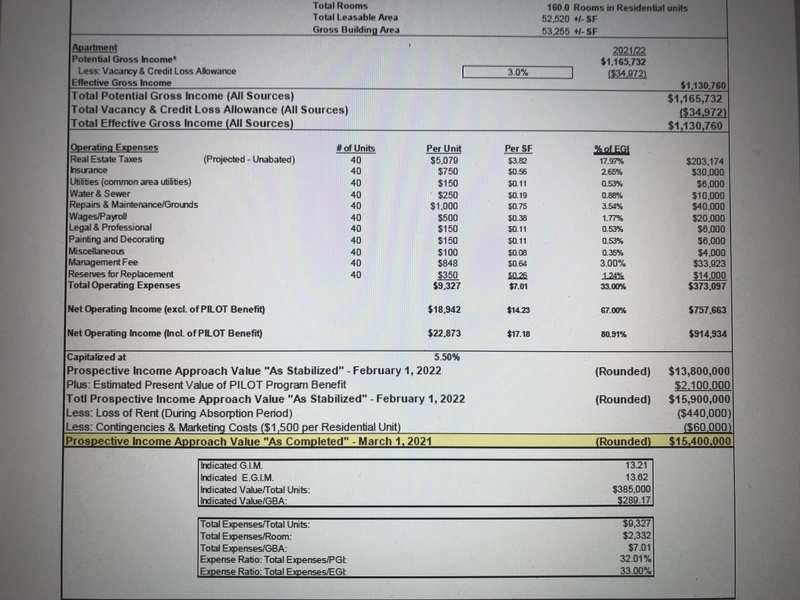
In order to formulate that, they will survey the market for similar units and apply a market derived rental rate for the units to arrive at the potential gross income. Then they will deduct a market based vacancy and credit loss rate to formulate effective gross income. Since the subject is vacant any historical operating statements are inaccurate as they do not represent the actual expenses occurred during occupancy. Therefore, they will most likely rely on a market derived expense survey from other similar buildings they have financed in the area. Real estate taxes will be based on the actuals, possibly adjusted if your area reassess upon sale. Other fixed and variable expenses would be based on the survey. Once they deduct the expenses the will arrive at a net operating income. Dividing the NOI by their selected cap rate will give them an Prospective "As Stabilized" market value at some date in this future, most likely around 6-8 months down the road.
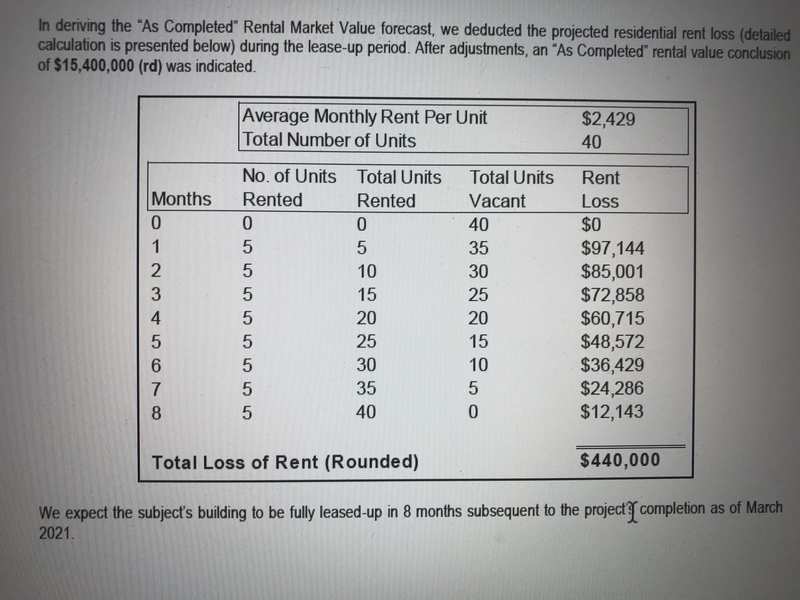
Now the must deduct the items and time to achieve stabilization; 6 months of rent loss or an abosortion rate based on the local market and leasing commissions if ownership pays those where you’re located. In order to arrive at an current “As Is” market value.
Since the property is vacant, the bank may hold off releasing funds until a certain stabilized level. Or you may need to seek other means of financing in the interim.
Just to summarize, make sure to deduct the costs and time to achieve stabilization from your concluded value.
Following up on my above post, I’ve attached two pictures illustrating the discount and rent absorption. Your “As Is” value is equal to the below pictures “As Complete” value as this was a proposed construction job. See below.
Also, disregard the PILOT benefit, that’s a tax exemption benefit specific to that development.
@Derek Magdziak I will assume here that this is for you to potentially purchase. As you know, a vacant building has a lower market value then one that is occupied. If you are trying to determine value for what the property could demand once filled, then yes you would have to develop a 'projected' pro forma based upon market rents in the area. After gathering a data set you can then make a prediction of value. However, I would not use this information gathered to determine your purchase price! For one, you will be negative cash flow day one. Secondly, you will no doubt have an abnormally high down payment. What you really want to do is determine the value "As-Is"...raw land and improvements because that is what your buying. The easiest way to do this is to get an appraisal. There are ways to do this yourself, but it is complicated and time consuming. Another option you would have would be to make filling a few of the vacancies as part of your agreement and using that income as your starting point for determining value.
@Kevin K. Thank you for your thorough explanation, and for the two pics! That does make sense to me.
@Erik Hatch You make a great point that financing could be difficult to obtain in properties that do not have any tenants. Totally agree with you that it'll be an uphill battle.
@Brett Peters Negative cash flow certainly is what I am strongly concerned with... and If the numbers don't work, then I have no issues walking away form my analysis (I have not submitted an LoI yet to start any negotiations, but it is an interesting property to analyze nonetheless).