New to Real Estate · Country wide · Member since 2021 · 2 posts · 1 vote
Good morning, I am looking to invest into real estate starting with my VA loan. I'm just wondering what are the best cities to invest in? And what are some tips you would recommend for beginners?
@Jacob Lasater You have to live in the home (or intend to) when you purchase with a VA loan. Are you looking for a dedicated investment property, but you're open to multiple locations? The "whats the best real estate market" question is very common and the answer is always "it depends".
Also, there is no “best” market that fits every investor! There is money to be made in every real estate market in the country, it’s just a matter of figuring out which market fits your strengths, your goals, and your strategy the best. The ‘best market’ question always leads me to ask follow up questions, such as: what are your long-term goals? What is your risk tolerance? Where do you have an advantage in the form of local knowledge, boots on the ground, or insight into the local economy?
I recommend people first determine their long-term goals for why they are even investing in real estate. Do you need the cash flow now or do you have a good-paying W-2 job that will allow you to focus more on markets expected to appreciate over time? Next, figure out how much capital you have access to for purchasing real estate. This is an important factor. It’s much more expensive to purchase an off-market single-family home in Southern California than Tulsa, Oklahoma.
Another important consideration is: how much time do you have to devote to investing? If you work a demanding 9-5 job or just don’t have the desire to put in the work to actively invest (and it is a lot of work!), maybe focusing on 100% passive real estate investments is a better fit.
Good luck on your real estate journey and keep us updated on your progress.
Thats hard to say. But I recommend not getting to wrapped up in this part. If your going VA, you will have to live there at least for a year. That should narrow your search down. People are investing in cities all over the country. To find a place to invest it just has to meet some basic requirements. 1. You have to be able to afford it. 2. Make sure their is enough demand for this market to support owning rentals. 3. It helps if its appreciating or up and coming. A lot of markets meet these requirements. I would decide on a location that makes most sense for YOU. Also consider how you will manage the property after you move again.
@Jacob Lasater You have to live in the home (or intend to) when you purchase with a VA loan. Are you looking for a dedicated investment property, but you're open to multiple locations? The "whats the best real estate market" question is very common and the answer is always "it depends".
Also, there is no “best” market that fits every investor! There is money to be made in every real estate market in the country, it’s just a matter of figuring out which market fits your strengths, your goals, and your strategy the best. The ‘best market’ question always leads me to ask follow up questions, such as: what are your long-term goals? What is your risk tolerance? Where do you have an advantage in the form of local knowledge, boots on the ground, or insight into the local economy?
I recommend people first determine their long-term goals for why they are even investing in real estate. Do you need the cash flow now or do you have a good-paying W-2 job that will allow you to focus more on markets expected to appreciate over time? Next, figure out how much capital you have access to for purchasing real estate. This is an important factor. It’s much more expensive to purchase an off-market single-family home in Southern California than Tulsa, Oklahoma.
Another important consideration is: how much time do you have to devote to investing? If you work a demanding 9-5 job or just don’t have the desire to put in the work to actively invest (and it is a lot of work!), maybe focusing on 100% passive real estate investments is a better fit.
Good luck on your real estate journey and keep us updated on your progress.
Thank y'all so much for the advice. I am currently a truck driver so I don't really live anywhere except on the road. However my first investment will be my primary residence and my financial source is the VA loan and my regular pay from trucking. So the real estate markets I've had my eye on is Nashville, Knoxville, and Charlotte. Although I am open for all over the country. My long term goals is to get into short term rentals and use the cash flow from that to invest into long term rentals or new builds.
If you have to live in the house, which you do with a VA, shouldn't the first question you ask yourself is where you want to live? This is the shortfall of new investors to think that investing means going somewhere to do it so you can do better. What areas do you know the best? Where do you want to live for the next year? Where do you live now? Do you have a non-remote job where you can't move anyway? A lot more work to do here.
There are always opportunities in each town. The larger the town the more opportunities though. The key is how the market is doing. If there upwards pressure on the market ie a Sellers Market or If there downwards pressure on the market ie a Buyers Market. The factors are figured out by checking specific supply and demand and average days on market. To me it does not matter where the deals are. It is finding the deals that is most important. There are plenty of deals all day long in the oceans we fish in.
@Jacob Lasater, Hi, if you have not, great books to read are: Rich Dad, Poor Dad The Millionaire Next Door Cash Flow Quadrant Tax Free Wealth Set For Life Rental Property Investing The Millionaire Real Estate Investor The REAL Book of Real Estate So Good They Can’t Ignore You
Hi Jacob,
Having a few initial screening metrics can help filter and vet potential markets. Items like population growth, rent growth, income growth, job growth and job diversification can help in the early stages of due diligence. From there you can have a clearer view into which metros fit your goals, timelines, etc. Best of luck to you.
The most important decision you will make is the location, not the property. As long as you buy a property in a "good" location, all but the worst mistakes will be corrected over time through appreciation and rent increases. However, if you do not buy in a "good" location, you can do nothing to turn things around after the fact. Fortunately, selecting a "good" location is relatively easy if you use the right metrics.
Rent and Price Growth Rate - Inflation is constantly eroding buying power; each year, it costs more to buy the same set of goods and services. If you buy in a location where prices and rents rise faster than the inflation rate, your buying power will increase due to the increased rents. If you buy in a location where prices and rents are increasing below the inflation rate, your only option will be to decrease your standard of living over time. Also, do not rely on the rapid increases resulting from COVID; these increases are not sustainable. Evaluate locations based on the ten years preceding the COVID times compared to the current inflation rate (>5%).
Population Size - Greater than 1 million. Small towns rely too much on a single business or market segment.
Population Growth - If people are moving into a location, many things have to be right, including jobs and the cost of doing business. Do not invest in any location where the population is stagnant or declining.
Crime - People and companies will not move to locations perceived as dangerous. One source of cities to avoid is Neighborhood Scout's 100 most dangerous cities.
Disaster Risk - Some parts of the country suffer frequent natural disasters. The best indicator for natural disaster probability is the cost of homeowners insurance. Avoid states with high insurance rates. Note, even if insurance pays for all the damage your property suffers, you still lose. When a significant disaster occurs, people and jobs move to locations where they can make money today. The location may take years to recover, or it may never recover. ValuePenguin is a good source for the relative cost of insurance by state.
I want to stress again that it is CRITICAL that you choose a location where pre-COVID appreciation is greater than the current inflation rate. If you choose a location where this is not the case, your first month's return will be the highest (inflation-adjusted) return you will ever receive from the property.
After location, the most important success factor is finding and working with a good investment team. If you needed surgery, you would not start medical school. Also, not just any doctor will do. You want a surgeon that specializes in the kind of surgery you need, not a general practitioner. The same is true with real estate investing. You want to work with an investment team that already has the skills and a proven track record of finding, qualifying, renovating, and managing properties. A good investment team will minimize your risk and save you time and money. If you try to do everything yourself, it will cost you more, and the odds of success are much lower. The place to start is with an investment Realtor, not an investment "friendly" realtor. Below are the skills and experience an investment Realtor and their team members provide at no cost to you.
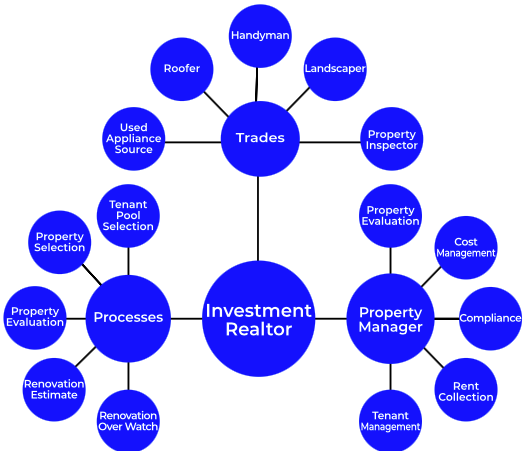
However, it may be hard to find an investment Realtor. Even in a large metro area, there is likely only one or at most two investment Realtors. While finding an investment Realtor may take time, the cost, risk, and time savings will be worth it.
If you choose a good location and work with a good investment team, you should do well.