Is a 1031 Exchange allowed in this case, and if so, is it worth the hassle?

Is a 1031 Exchange allowed in this case, and if so, is it worth the hassle?

Member since 2021 · 10 posts · 2 votes

Posting for my elderly parents.

Background: my parents bought their house in 2001 for $355K. In 2016 they moved to a one story home due to aging and ended up renting their initial home. Every year the rental has been depreciated by $11,700/year, so for the past 9 years that would be about $105K in depreciation. They are getting ready to list this house for sale in the next few weeks, listing price is $1,075,000. The plan is to use the proceeds from this rental to buy another rental property for about $650-700K, plus to pay off the home that they live in now ($260K owed).

The dilemma is: 1. Would the IRS allow them to benefit from a 1031 Exchange if they would be "swapping" a million-dollar rental for one that is much lower in price? 2. If so, is it even worth it? Would they be able to defer a good amount in taxes, to be worth the hassles of the 1031 exchange and the time constraints on the purchase? 3. If they don't do a 1031 how much would they have to pay in taxes after selling their rental? Roughly? Their combined income is below $100K per year. If it matters, they now live in Oregon, current rental is in California, and the new rental will be purchased in Illinois. TIA

1Reply
103 views

Most Popular Reply

George SkidisPro Member
Rental Property Investor · Belleville, IL · Member since 2017 · 875 posts · 529 votes
1y

Not an attorney and don't play one on television. A 1031 must be for equal or greater value or the funds in excess of the value of the new purchase are taxable. The exchange must also be for like kind and quality. So house for house, apartment building for apartment building.

Have your parents considered renting the house they are living in for two years and moving back into the rental unit for 25 months. When a rental is taken out of service for personal use the accumulated depreciation goes away over a short period of time. 

After 25 months, If they can prove that they lived in the property for two of the past five years, they can sell it as an owner-occupied residence. That sale should qualify for the $500,000 sale of personal residence exemption for tax purposes. Then they could move back into their current home. 

See this reply in the discussion

22 Replies

Jump to latestLatest
  • Member since 2021 · 10 posts · 2 votes
    1y

    @Dave Foster you seem to be a pro in this area, would you mind sharing your view on my parents' situation above?  Thanks so Much!!

    Anca

  • Member since 2024 · 99 posts · 174 votes
    1y

    Hi Anca, a 1031 has to be to a property of equal or greater value.

  • Member since 2021 · 10 posts · 2 votes
    1y
    Quote from @Brett Henricks:

    Hi Anca, a 1031 has to be to a property of equal or greater value.


     Thanks Brett, it is my understanding that by buying a property of equal or greater value it would allow for maximizing the tax deferral, which is ideal, but not a legal requirement?  Is my understanding incorrect?  Thanks again!

  • George SkidisPro Member
    Rental Property Investor · Belleville, IL · Member since 2017 · 875 posts · 529 votes
    1y

    Not an attorney and don't play one on television. A 1031 must be for equal or greater value or the funds in excess of the value of the new purchase are taxable. The exchange must also be for like kind and quality. So house for house, apartment building for apartment building.

    Have your parents considered renting the house they are living in for two years and moving back into the rental unit for 25 months. When a rental is taken out of service for personal use the accumulated depreciation goes away over a short period of time. 

    After 25 months, If they can prove that they lived in the property for two of the past five years, they can sell it as an owner-occupied residence. That sale should qualify for the $500,000 sale of personal residence exemption for tax purposes. Then they could move back into their current home. 

  • Investor · Clairemont, CA · Member since 2011 · 3k+ posts · 2k+ votes
    1y

    I don't know that @Dave Foster earlier mention worked...

    I'll let him chime in as the expert, but you can 1031 for less it just results in 'boot' which is taxable. Whether it still makes sense will depend on how much you can defer vs. the basis.

  • Member since 2021 · 10 posts · 2 votes
    1y
    Quote from @George Skidis:

    Not an attorney and don't play one on television. A 1031 must be for equal or greater value or the funds in excess of the value of the new purchase are taxable. The exchange must also be for like kind and quality. So house for house, apartment building for apartment building.

    Have your parents considered renting the house they are living in for two years and moving back into the rental unit for 25 months. When a rental is taken out of service for personal use the accumulated depreciation goes away over a short period of time. 

    After 25 months, If they can prove that they lived in the property for two of the past five years, they can sell it as an owner-occupied residence. That sale should qualify for the $500,000 sale of personal residence exemption for tax purposes. Then they could move back into their current home. 


     Thank you George!  My parents are 83 and 86, and can't move back into the California rental at their age...  They need a lot of daily support, therefore we moved them to Oregon so my sister can look after them...  Such a sad situation we are in, as their life's savings are at stake here...  And the new rental we want to buy would be in Illinois because that's where I reside, so I can look after that rental.   

  • Member since 2021 · 10 posts · 2 votes
    1y
    Quote from @Matt Devincenzo:

    I don't know that @Dave Foster earlier mention worked...

    I'll let him chime in as the expert, but you can 1031 for less it just results in 'boot' which is taxable. Whether it still makes sense will depend on how much you can defer vs. the basis.


     Thanks, and we are OK to pay taxes on the boot, as long as we can salvage some $$ by buying a new rental.  But so far I am getting the sense that we would not be allowed to do the partial 1031 exchange from the responses so far?

  • Investor · Clairemont, CA · Member since 2011 · 3k+ posts · 2k+ votes
    1y

    @Anca R. no I'm saying the opposite. You can do an exchange for less than the full amount, but you will owe taxes on the boot. As far as some other comments about like kind etc, you can sell this SFR and then buy a warehouse, or vacant land or even exchange into a DST there are many other assets that are considered 'like kind'. So the question becomes based on their individual and personal tax situation what is the estimated tax burden they'd save?

    Once Dave chimes in I think you'll have a better perspective on what that could be...

  • Member since 2021 · 10 posts · 2 votes
    1y
    Quote from @Matt Devincenzo:

    @Anca R. no I'm saying the opposite. You can do an exchange for less than the full amount, but you will owe taxes on the boot. As far as some other comments about like kind etc, you can sell this SFR and then buy a warehouse, or vacant land or even exchange into a DST there are many other assets that are considered 'like kind'. So the question becomes based on their individual and personal tax situation what is the estimated tax burden they'd save?

    Once Dave chimes in I think you'll have a better perspective on what that could be...


     Awesome, thank you Matt!!  We are looking to buy a condo in Chicago as the new rental, for a variety of reasons, but most importantly because it would rent better in the city, and it fits our desired price point (so we can allow for the rest of $$ from the sale for paying off their Oregon home and pay all, or some of the taxes on the boot).  As long as we would be legally allowed to proceed with this plan, then the question remains, as you point out, what is the tax burden for the partial 1031 exchange.

  • Dave FosterBusiness Member
    Qualified Intermediary for 1031 Exchanges · St. Petersburg, FL · Member since 2013 · 9k+ posts · 9k+ votes
    1y

    @Anca R. and everyone, thanks for the shout out.

    To simplify the process the best I can, I'll address and break down each concern.

    1. In order to defer all of the tax, you must purchase at least as much as your net sale and use all of the proceeds. if you purchase less than what your net sale you would have to pay tax on the difference, and you would shelter whats left of the gain.

    2. To really know if a 1031 exchange is worth it for you, you first must find out what your net gain is and subtract state and federal taxes from that. Your net gain is your net sale, minus your adjust cost basis.

    Net Sale - Is the contract price, minus the closing costs and commissions.

    Adjust cost basis - Is the purchase price, plus capital improvements, minus depreciation.

    Net sale - adjust cost basis = net gain

    After you know what your net gain is then you can figure out what your state and federal tax burden would be.

    The last thing is you must use all of the net proceeds in your exchange. If any of the proceeds touch the sellers hand the IRS sees it as taking profit and you will have to pay taxes on that portion.

    Net proceeds - Is the net sale, minus any Equity in home being sold.

    I find a lot of investors who want to purchase less than their reinvestment requirements will do the calculation to see what their tax burden would be if they purchase less than they sell. If the difference is too much then they will purchase multiple properties using all of the proceeds. If you are selling for 1M after closing costs you could purchase two 500k properties in your exchange and own one cash and a mortgage on the second.

    The bottom line is that your scenario is possible. But. you'll have to see what your net gain is before you can see if you'll save any money with your 1031 exchange.

    The 1031 Investor5137 Reviews
  • Member since 2021 · 10 posts · 2 votes
    1y
    Quote from @Dave Foster:

    The bottom line is that your scenario is possible. But. you'll have to see what your net gain is before you can see if you'll save any money with your 1031 exchange.

    Dave, thank you kindly for your detailed response, I really appreciate it.

    I did the calculations, and here's where we are:

    Net Gain is $750K, and Net Proceeds are $280K.

    Given that the net sale price is $1,000,000 and we are looking to buy a condo for about $700K, what is the dollar amount we would be paying taxes on?  Is it the difference between the net gain (i.e. $750K) and purchase price?  Or on the difference between the net sale price ($1,000,000) and the purchase price of the new rental, i.e paying taxes on $300K?  Thanks so much for the clarification, Dave! 


  • Real Estate Agent · Chicago · Member since 2021 · 168 posts · 62 votes
    1y

    Hi Anca,

    It sounds like your parents are in an exciting but complex situation—kudos to you for helping them navigate it! Here are some insights that might help:

    1. 1031 Exchange Feasibility: Yes, a 1031 Exchange is possible even if they’re purchasing a lower-priced property. However, any funds not reinvested in the new property (the difference between the sale price and purchase price, after closing costs) would be considered “boot” and taxed accordingly.
    2. Is It Worth It?: A 1031 Exchange can defer a significant amount of capital gains tax, so it’s often worth it for high-value transactions. However, the process can be complex, with strict timelines (e.g., identifying a replacement property within 45 days and closing within 180 days). Consulting a tax advisor or 1031 Exchange expert is essential to determine if the benefits outweigh the hassle.
    3. Taxes Without a 1031: Without the exchange, your parents will owe capital gains taxes. The calculation involves:
      • Selling Price: $1,075,000
      • Original Purchase Price: $355,000
      • Depreciation Recapture: $105,300 (taxed at 25%)
      • Capital Gains: Sale price minus original cost, minus depreciation, minus selling costs (~15-20% federal capital gains rate for their income bracket).
      • State Taxes: Since the property is in California, state capital gains taxes will also apply.

    Given the multiple layers, I’d highly recommend your parents work with both a CPA experienced in real estate and a qualified intermediary for the 1031 if they choose that route.

    If you need recommendations for professionals in Illinois or California, feel free to ask!

    Best of luck,

    Jarret

  • Member since 2021 · 10 posts · 2 votes
    1y
    Quote from @Jarret Jarvis:

    Hi Anca,

    It sounds like your parents are in an exciting but complex situation—kudos to you for helping them navigate it! Here are some insights that might help:

    1. 1031 Exchange Feasibility: Yes, a 1031 Exchange is possible even if they’re purchasing a lower-priced property. However, any funds not reinvested in the new property (the difference between the sale price and purchase price, after closing costs) would be considered “boot” and taxed accordingly.
    2. Is It Worth It?: A 1031 Exchange can defer a significant amount of capital gains tax, so it’s often worth it for high-value transactions. However, the process can be complex, with strict timelines (e.g., identifying a replacement property within 45 days and closing within 180 days). Consulting a tax advisor or 1031 Exchange expert is essential to determine if the benefits outweigh the hassle.
    3. Taxes Without a 1031: Without the exchange, your parents will owe capital gains taxes. The calculation involves:
      • Selling Price: $1,075,000
      • Original Purchase Price: $355,000
      • Depreciation Recapture: $105,300 (taxed at 25%)
      • Capital Gains: Sale price minus original cost, minus depreciation, minus selling costs (~15-20% federal capital gains rate for their income bracket).
      • State Taxes: Since the property is in California, state capital gains taxes will also apply.

    Given the multiple layers, I’d highly recommend your parents work with both a CPA experienced in real estate and a qualified intermediary for the 1031 if they choose that route.

    If you need recommendations for professionals in Illinois or California, feel free to ask!

    Best of luck,

    Jarret


     Thank you Jarret for the detailed analysis above.  So if they buy a condo for $700K as part of a 1031 exchange what is the portion they would have to pay capital gains to?  I agree we need to work w/ a CPA for their 2025 income taxes, and will be looking for a recommendation soon.  Thanks again!

  • Dave FosterBusiness Member
    Qualified Intermediary for 1031 Exchanges · St. Petersburg, FL · Member since 2013 · 9k+ posts · 9k+ votes
    1y

    @Anca R., the calculation of tax you'll owe is very straight forward.  Any amount you purchase less than you sell, or any amount of cash you take out is considered to be profit.  If you sell for a net sales price of $1 mil and buy for a net purchase price of $700K you will owe tax on the difference of $300K.

    BP may have a capital gains calculator you can use.  There's also a calculator on my website that will help you navigate different scenarios.

    The 1031 Investor5137 Reviews
  • Linda WeygantPro Member
    Investor and CPA · Arvada, CO · Member since 2015 · 2k+ posts · 3k+ votes
    1y
    Quote from @George Skidis:

    Not an attorney and don't play one on television. A 1031 must be for equal or greater value or the funds in excess of the value of the new purchase are taxable. The exchange must also be for like kind and quality. So house for house, apartment building for apartment building.

    Have your parents considered renting the house they are living in for two years and moving back into the rental unit for 25 months. When a rental is taken out of service for personal use the accumulated depreciation goes away over a short period of time. 

    After 25 months, If they can prove that they lived in the property for two of the past five years, they can sell it as an owner-occupied residence. That sale should qualify for the $500,000 sale of personal residence exemption for tax purposes. Then they could move back into their current home. 


     This is not correct.  You are quoting old rules.

    New rules have a calculated period of Qualified vs Non Qualified usage.  So while moving back into it for 2 years does bring the 121 exclusion back into play, that exclusion is reduced based on the percentage of Non Qualified usage over the holding period.  

    And Depreciation Recapture never goes away.  Not sure where you picked that up from, but it's not correct.  Depreciation Recapture is calculated on any property that was ever depreciated, regardless of elapsed time or usage before/after the rental period.

  • Linda WeygantPro Member
    Investor and CPA · Arvada, CO · Member since 2015 · 2k+ posts · 3k+ votes
    1y
    Quote from @Daniel Osman:

    @Anca R. Hi! There have been a ton of great responses here! 

    As others have said a partial exchange is possible, and common. Your parents can look to reinvest the remaining proceeds into a DST, tenancy in common investment, NNN, that are passively managed. This would allow them to fully defer their taxes if that was their goal.

    This 1031 Exchange Calculator can help you model out the taxable proceeds based on various situations. 

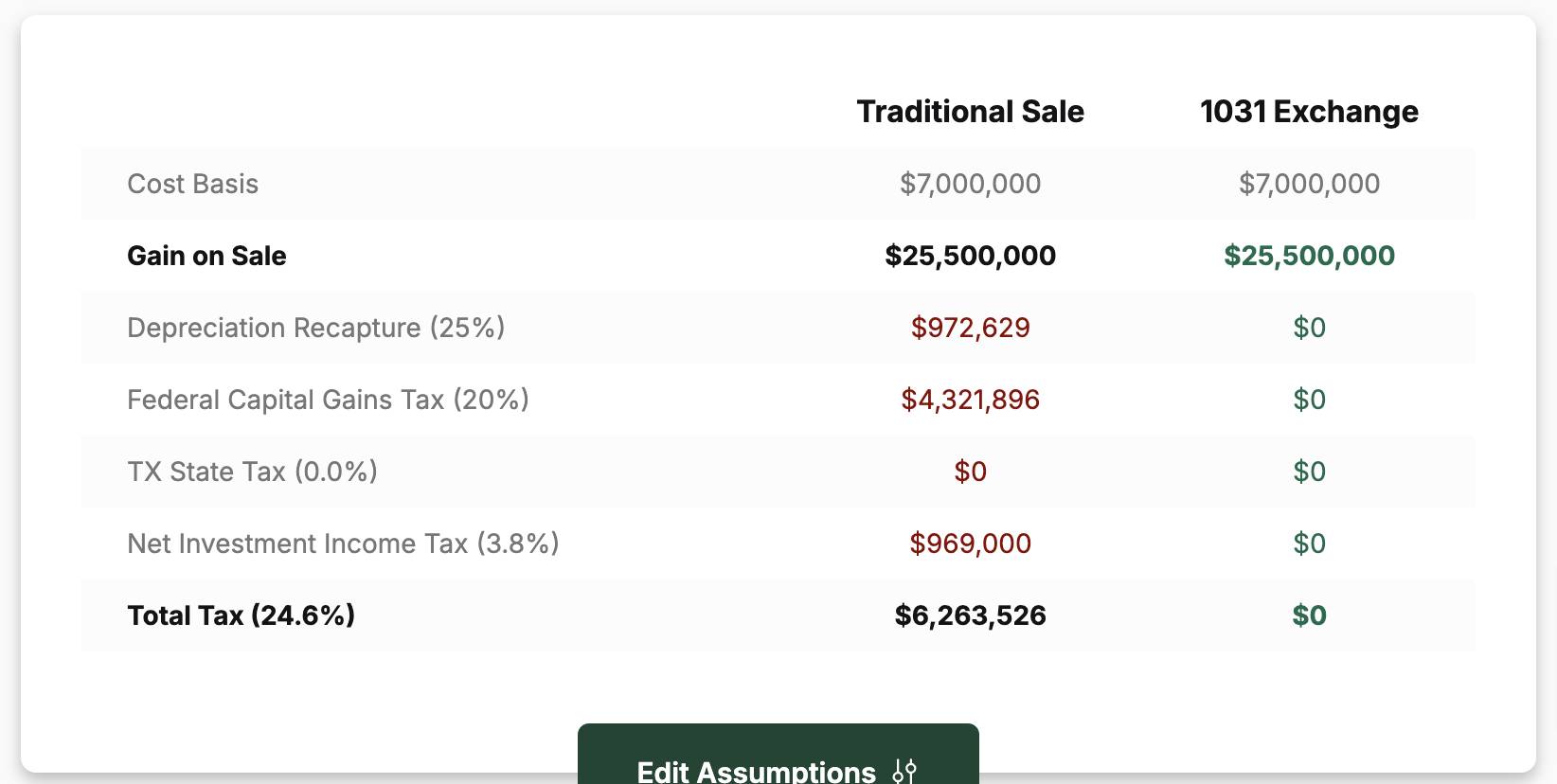
    To give you an idea of what taxes look like on a sale below is an example for a property in Texas, obviously everyone's situation is unique and you'll need to meet with a CPA. 

    Hope this was helpful! 

    Was just about to advise the same. A DST is like owning a property in a partnership, but is technically held in the same name as what the old property was held.

    So, Anca, your parents can 1031 from one property into more than one.  THEY ARE NOT LIMITED TO ONE PROPERTY.

    So, they can 1031 to 2 or more additional properties OR 1031 into a rental property plus a DST so that all the profits are used up in the exchange. Definitely get with a qualified tax professional on this.

  • Denver McClurePro Member
    Financial Advisor · Flower Mound, TX · Member since 2018 · 661 posts · 479 votes
    1y

    Hey @Anca R., lot's of great comments to your post! One thing I would mention is if you go the DST route, speak to an Investment Advisor and a Broker/Dealer. Understand the difference between the two, how they are compensated, and how they serve you during the due diligence process.

  • Ashish AcharyaBusiness Member
    CPA, CFP®, PFS · FL · Member since 2017 · 5k+ posts · 3k+ votes
    1y

    @Anca R. A 1031 Exchange is possible for your parents’ situation, as long as they reinvest the proceeds into like-kind investment properties. However, swapping a $1,075,000 property for one worth $650-700K creates a "boot" (unreinvested funds), which will be taxable. Taxes will still be owed on the boot plus depreciation recapture (approximately $105K taxed at a 25% rate). Depending on the loan amount for the new property, roughly a little over half of the gain could be deferred through the exchange.

    Without a 1031, they’ll face taxes on the entire gain, including federal capital gains tax (likely 15% based on their income), California state tax, and depreciation recapture, potentially totaling $130-150K. If paying off their primary home is the priority and the tax savings from the 1031 don’t outweigh the boot and logistical constraints, selling outright may be simpler.

    This post does not create a CPA-Client relationship. The information contained in this post is not to be relied upon. Readers should seek professional advice.

    INVESTOR FRIENDLY CPA®5241 Reviews
    TaxMD® | Tax Planning Software
  • Member since 2021 · 10 posts · 2 votes
    1y

    @Ashish Acharya your answer is straight and to the point, thank you.  So if we go w/ the $700K purchase price of the new rental (paid in cash from the proceeds), that leaves them w/ $300K to pay capital gain on, @15%, totaling $45K.  Add that to about $25K tax for the depreciation recapture, that would be paying a total of $70K in tax if they do the 1031 exchange.  If no exchange, it is my understanding that they would be paying capital gains to about 750K ($1M minus depreciated value of $255K), which would be roughly $120K, plus $25K for the recapture tax, that is $145K in taxes, or even more, as you pointed out.  Is my understanding correct?  If so, it sounds like the 1031 exchange makes sense?  Because after purchasing the new rental for $700K that leaves them $300K initially, so take $260K to pay off their mortgage, and still enough left to cover a good chunk of the taxes owed. 

  • Ashish AcharyaBusiness Member
    CPA, CFP®, PFS · FL · Member since 2017 · 5k+ posts · 3k+ votes
    1y
    Quote from @Anca R.:

    @Ashish Acharya your answer is straight and to the point, thank you.  So if we go w/ the $700K purchase price of the new rental (paid in cash from the proceeds), that leaves them w/ $300K to pay capital gain on, @15%, totaling $45K.  Add that to about $25K tax for the depreciation recapture, that would be paying a total of $70K in tax if they do the 1031 exchange.  If no exchange, it is my understanding that they would be paying capital gains to about 750K ($1M minus depreciated value of $255K), which would be roughly $120K, plus $25K for the recapture tax, that is $145K in taxes, or even more, as you pointed out.  Is my understanding correct?  If so, it sounds like the 1031 exchange makes sense?  Because after purchasing the new rental for $700K that leaves them $300K initially, so take $260K to pay off their mortgage, and still enough left to cover a good chunk of the taxes owed. 

    A 1031 exchange is a smart choice for your parents, reducing immediate taxes to $70K (capital gains on $300K boot + $25K depreciation recapture) versus $148K without it. Reinvesting $700K defers most taxes, preserves equity, and allows continued depreciation benefits. The leftover $300K can cover their $260K mortgage and other needs. Holding the new property until passing offers a step-up in basis, eliminating deferred taxes for heirs. Ensure compliance with 45-day identification and 180-day closing rules.

    This post does not create a CPA-Client relationship. The information contained in this post is not to be relied upon. Readers should seek professional advice.
    INVESTOR FRIENDLY CPA®5241 Reviews
    TaxMD® | Tax Planning Software
  • Member since 2021 · 10 posts · 2 votes
    1y
    Quote from @Ashish Acharya:
    Quote from @Anca R.:

    @Ashish Acharya you rock!  Regarding your comment below:

    "Holding the new property until passing offers a step-up in basis, eliminating deferred taxes for heirs." How do we take advantage of that? At my parent's passing they will own three homes, all paid for. Their wish is to give one home to each daughter (we are three sisters). So what is the procedure by which to accomplish that? I've heard that maybe one way to do it is to put one home in an LLC in their names and one of the daughters. But we don't know how it works for the tax implications of that for the hairs...Or would a trust be better? But then, do all three homes go into ONE trust, listing the two parents and the three daughters, or do they create three trusts? Many thanks in advance.


    This post does not create a CPA-Client relationship. The information contained in this post is not to be relied upon. Readers should seek professional advice.

Join the conversationCreate a free account to reply, vote on answers and follow this thread.