Madison, WI · Member since 2014 · 62 posts · 10 votes
I have been told that sub-metering this building is not a possibility (without spending ALOT of money to redo the plumbing). Currently, we divide the water bill among all the units every 6 months and bill the tenants. This system was inherited from the previous owner and the tenants don't like it, for obvious reasons... some units have 1 person and some have 3 or 4 people using water. It is not fair and I agree, but how else can we do it? I have thought of charging based on the # of people in a unit, but that of course will encourage dishonesty in reporting the # of people in a unit and I'm not even sure that is a fair way to do it either.
Beyond creative ways of dividing up the water bill -- maybe I could figure out a way to sub-meter the units creatively? Apparently there is not a separate hot/cold line for each unit, but I assume it has to branch of somewhere. Are there small meters I could install in the units themselves? There are essentially 7 water lines in each apartment (as I see it, but I am no plumber): hot/cold for the kitchen sink, hot/cold for the bathroom sink, hot/cold for the shower and the toilet. Would it be insane to install a meter on each of those lines? I suppose that might end up being just as expensive... thinking out loud here.
Wow, I would check with your state laws first. In my state, its illegal to charge units like that. The only way to charge units is by meter and I think the rule initially was in order to go sub-metering we needed a license plumber to install all water savings devices in that unit. Since then, I heard Massachusetts now allows as long as a license plumber verifies the water savings devices.
My solution to this dilemma was base average usage on occupancy and previous water bills, building in an annual increase of 1% by the water/sewer company for an 18-24 month period. I positioned my rent $100 over market rate and wrote in my lease that if water bill went over a certain dollar amount they would be responsible for anything over that amount. They initial and sign lease to that effect. I was up front with tenants before they signed the lease, showing them previous water bills with average usage. This makes good tenants a little more cautious in their water use to avoid paying extra rent. I always use past bills as a benchmark to what I will up-charge for rents. I only have two units on one property with one water line however.
Utility segregation is a fantastic way to add value, BUT its not always easy and its typically not cheap. Depending on how the utilities were run when the building was constructed this can be easy or nearly impossible. For example if you have one main water line that runs through out the building and smaller lines branch off it to feed one unit which then feeds another unit and so on. You will have to rip open the walls and run all new lines back to your service entry where meters can be installed. Also to separate water would require installing separate hot water heaters for each unit. Depending on if the hot water heater is gas or electric you may have to 1) run new gas lines and exhaust pipe to correctly vent the carbon monoxide. 2) run new electric to each hot water heater. because the additional electrical demand this would cause you may have to upgrade your service (circuit breaker panel).
Check your laws!! I don't know your state but what your doing with water bill back sounds illegal.
I believe in the future a massive shift in demand for sub metered properties will happen as water prices continue to rise.
I will be closing on a 42 unit in a couple weeks where gas and electric were sub metered when the property was built (1989). Landlord currently pays water but what we found when searching was the water lines are individually ran to each unit and each unit has its own HWH. This means placing a meter at the start of each water run. We can sub meter each unit for roughly $200. This process will pass on the $28,000 annual water bill to the tenants. The property is a 8 cap which means the savings will increase our property value $350,000 with only a $8,200 investment.
Word of caution. When considering sub-metering, you have to realize what the market is accepting. If you are the only building charging for gas, electric and water while all others around you are not but you try to charge the same amount in rent as the other guys, it wont work.
Attached is a very simple graph to show you why one of my underwriting criteria has been the sub metering of water.
If you can't use individual meters, then it will never be "fair", and there will always be waste, this is just a fact you will have to accept. This is why multi unit buildings without meters are not worth as much when it comes time to sell.
Do the units have their own water heaters? You can put a meter on the water heater and calculate their bill based on a percentage of hot to cold water use. Still not accurate but about as close as you can get without meters in the right places...
To save on the brain damage I would consider either doing it via head count, or something like square footage of the unit. Granted, that doesn't help if 4 people live in a 2-bed and 2 people live in the other 2-bed, but no one is incentivized to lie about occupancy and you still charge it through. I don't know anything about utility bill-back, but just looking at the problem from the "how many grey hairs" perspective.
I don't think it is illegal in WI, as the law reads like this:
(3)Utility charges. If charges for water, heat or electricity are not included in the rent, the landlord shall disclose this fact to the tenant before entering into a rental agreement or accepting any earnest money or security deposit from the prospective tenant. If individual dwelling units and common areas are not separately metered, and if the charges are not included in the rent, the landlord shall disclose the basis on which charges for utility services will be allocated among individual dwelling units.
Even so, I would still like to divide it up more fairly somehow. Charging per head is a thought I had, but I have a feeling that the tenants are already not 100% honest about occupancy and this would make that problem worse. It might be the best option even so.
I'm going to some more analysis on what on the value increase vs cost for installation of sub-metering, but my back of the napkin calculations a couple months ago didn't make sense to do it. Thanks for all the feedback it is very helpful.
You have a property with two or more units and the utility meters are shared. There are a few options.
1. Pay to separately meter the utility. This can be very expensive and is usually the worst choice to make because you can't justify the cost.
2. Charge the tenants a higher rent rate and include utilities with their rent. This is the simplest method, but it also means your tenants are more likely to abuse the utilities by leaving windows open with the heat or A/C running, leaving lights on, ignoring the toilet that constantly flushes on its own, etc.
3. Pay the bill yourself, then reimburse yourself by charging the tenants based on a formula. This takes a little more work, but it's the most fair and reduces the likelihood of tenants that squander utilities.
If you choose #2 or #3, there are considerations:
Start with an average. Use varies throughout the year. Heating costs go up in winter, as does electric due to the reduced natural light and people being indoors more. Electric can also spike in the summer with A/C. Contact the utility provider and get an historical average based on the last year of use. It won't be 100% accurate, but it will be close enough. I recommend you do this each year to adjust for utility increases and other variables. If your average heating bill is $150, you may not collect enough in the winter months when the bill reaches $225 but you'll collect extra in the summer when it drops to $65. If you base your tenant charges on the historical average, you should come very close to collecting the entire amount over a one-year period.
Charge a higher rate. If the water bill is $100 a month, increase the price by 20% (or whatever you decide is fair) to compensate you for the time required to split and bill and to cover additional use when tenants squander the utility. If the bill is $100 a month split between four units, increase it to $120 and charge each tenant $30.
How to calculate charges. Don't make it harder than it has to be. If you have four 2bed/1bath units with the same appliances, split it four ways and call it a day. You can make minor adjustments based on the type of appliances (dishwasher, clothes washer and dryer, air conditioning, etc.) and the size of the rental. If Apartment A is a 2bed/1bath with washer/dryer and Apartment B is a 1bed/1bath with no washer/dryer, Apartment A should pay a higher rate. Another option is to split the cost based on the number of occupants in each unit but this also means you'll need to adjust the charges as tenants move in/out, so it requires more work and I wouldn't recommend it. I recommend a simple spreadsheet to check your math and it will make it simple to adjust each year.
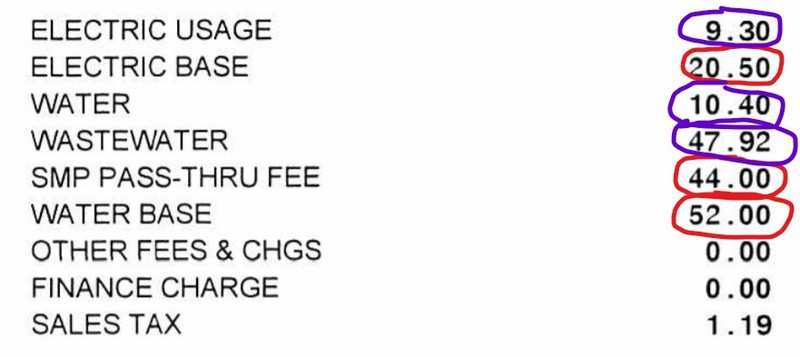
End the complaints. Tenants may complain about your method of calculating how much each unit pays. They think it's unfair because they only shower once a week but they can hear the upstairs neighbor showering twice a day. You can put an end to this by showing them a bill. Why? Because a large percentage of the charges are base fees! Look at the example below. All the charges circled in red are base fees. Charges in blue are the actual usage charges. If your tenants had their own meter, they would be paying 100% of the base fees on top of their actual usage.
In this example, the total charge is $184.12. Divide that between four units and each tenant will pay $46.03. If they were separately metered, each tenant would pay $116.50 for base fees and their individual use, which is 3x higher than what they're paying when they share a meter.
There are a lot of options out there, but don't make it more complicated than it needs to be. Tenants actually save money when using a shared meter, so there's plenty of room for error when calculating how to distribute the charges.
1. My water/sewer is billed quarterly. The bills are amazingly consistent. 2. My market's multi-family landlords all pay water.
3. Because of this it is very simple to factor it in to rents.
4. I have had potential tenants from neighboring towns come in and LOVE this, Some of their landlords do the RUBS system which is a socialism-like system that rewards water wasting families and punishes young professionals.
5. Figure out your numbers, send a notice out with the new lease and rent increase and inform the tenants that you will be paying water moving forward. If they are unhappy they can move on. Just remember- every new tenant is going to see it as a selling point, rather than a compromise. They will see "Landlord pays water" and that is big.
6. Then when you put in water conserving shower heads and toilets you will get the profit of the lower bills. Our water bills went down with renovations we scored big- over $2,000 yearly savings on both buildings.
And then those young professionals moved in and they use even less because they are either working or out enjoying life!
Utility segregation is a fantastic way to add value, BUT its not always easy and its typically not cheap. Depending on how the utilities were run when the building was constructed this can be easy or nearly impossible. For example if you have one main water line that runs through out the building and smaller lines branch off it to feed one unit which then feeds another unit and so on. You will have to rip open the walls and run all new lines back to your service entry where meters can be installed. Also to separate water would require installing separate hot water heaters for each unit. Depending on if the hot water heater is gas or electric you may have to 1) run new gas lines and exhaust pipe to correctly vent the carbon monoxide. 2) run new electric to each hot water heater. because the additional electrical demand this would cause you may have to upgrade your service (circuit breaker panel).
Check your laws!! I don't know your state but what your doing with water bill back sounds illegal.
I believe in the future a massive shift in demand for sub metered properties will happen as water prices continue to rise.
I will be closing on a 42 unit in a couple weeks where gas and electric were sub metered when the property was built (1989). Landlord currently pays water but what we found when searching was the water lines are individually ran to each unit and each unit has its own HWH. This means placing a meter at the start of each water run. We can sub meter each unit for roughly $200. This process will pass on the $28,000 annual water bill to the tenants. The property is a 8 cap which means the savings will increase our property value $350,000 with only a $8,200 investment.
Word of caution. When considering sub-metering, you have to realize what the market is accepting. If you are the only building charging for gas, electric and water while all others around you are not but you try to charge the same amount in rent as the other guys, it wont work.
Attached is a very simple graph to show you why one of my underwriting criteria has been the sub metering of water.
Feel free to reach out if I can help.
.
Hi Jered, Do you remember what manufacturer's sub-metering products you used? Do they automatically report usage via the cloud etc? Thank you!