One stated benefit of investing in real estate is price appreciation. However, if you look at inflation adjusted real estate prices for the most part there isn't much appreciation. There are specific points in time like 2006 (we know what followed that) and right now when real estate exceeds inflation adjusted prices. However, over the long term it doesn't really appear that real estate appreciates much beyond inflation. Is real estate appreciation a myth?
37% of the inflation index is a housing component, and the largest component of the index. So essentially rising real eatate prices are the definition of inflation.
Real estate isn't purchased at a steady position however. It is typically purchased at a leveraged position. So of you are at a 4-1 leveraged position (20% down, 80% LTV), then you out perform inflation by a factor of 4, before even counting in rent or debt pay down. If you bought in at 3% down, you are at a 33.33-1 leveraged position and you beat inflation by a factor of 33.33 times...or a return of 3,333% per year versus inflation.
@Justin Colletti I have never understood the fascination with gold. If you bought an ounce at market in 2011 you paid $1,500. You'd pay about $1,000 today. How is it different than any other commodity? No dividends. No rents. Questionable capital gain. You might as well be holding rocks.
I like to think there will one day Musk's rocket will discover a planet made entirely of gold. So much so intrinsic value; gold will be handed out as a loss leader.
@Joe Villeneuve The one gap I see in your position is that you can use equity to borrow what you would call "real money." I think your response would be it's not real money if it's recourse debt but how would you explain nonrecourse debt? Equity has present value. You can't deny that.
In our financial system, monetary inflation and asset appreciation are related. Assets purchased at one point in time appreciate over time compared to the value of money over the same time period. Since nothing exists in a vacuum, it's hard to look at RE appreciation without comparing that to the appreciation of something else.
Kind of. But it's slightly different if you really look under the hood of what's going on.
What's actually happening underneath it all is that the house itself is still a depreciating asset... It's just that the dollars are depreciating faster than the house! :-)
I think that's important to recognize. When you look through the lens of seeing things in "real terms" rather than "dollar terms" everything that occurs in the economy starts to make a lot more sense.
@Justin Colletti I have never understood the fascination with gold. If you bought an ounce at market in 2011 you paid $1,500. You'd pay about $1,000 today. How is it different than any other commodity? No dividends. No rents. Questionable capital gain. You might as well be holding rocks.
I like to think there will one day Musk's rocket will discover a planet made entirely of gold. So much so intrinsic value; gold will be handed out as a loss leader.
Apologies Darius, but most of that is a bit off.
1. Your numbers are wrong on the gold price. Gold is about $1900 the last I checked. But you are picking the top of the prior peak as your starting point. If you go by the gold's most recent bottom—around $1050 just before the start of 2016—then it's up nearly 100% in the past 6 years. Not bad. But it's still incredibly undervalued compared to paper assets by any reasonable historical measure. And it is now on the rise again.
2. Gold has arguably been the best performing asset of the 21st century for most of the 21st century. You have to remember that is started at more like $200-$300 at the turn of the millennium. It shot up to nearly $2,000, not too far from a 600%-900% increase in 10 years, before retracting back halfway, which is not uncommon after such a spectacular run. And now, it's clearly on the move "up" again.
3. Gold is a commodity, but it is distinctly different than other commodities in that it is the most stable commodity in value on planet earth. Due to its unique supply and demand fundamentals, it is more stable in long term value than any other physical good or financial asset on earth. (Yes, including dollars.)
4. This means that in reality, gold doesn't actually go "up" or "down". Since it is the most stable asset in value on earth, it is more reasonable to view gold as the denominator. By any reasonable analysis, gold stays relatively static in value, and everything else moves in value around it. If you try to do this kind of analysis with every single asset on earth (dollars included) it quickly becomes clear that using gold as the unit of account is the most sensible option available.
5. If you believe that the gold price is "volatile" because you see it moving up and down in dollar terms, you are like a man on a rowboat on a choppy sea, looking at the shore, wondering why the lighthouse is bobbing up and down. (In this analogy, the dollar is the rowboat, the lighthouse is gold.)
Obviously, this is silly. Empirically speaking, the lighthouse is more stable than the boat, and gold is more stable than the dollar.
For example, whatever the dollar price of oil is, it keeps on trading in a shockingly stable range against gold for literally 150+ years. (As long as we have records.) This is true for not only gold, but basically everything we have data for: houses, stocks, wheat, pork bellies, copper, iron, a college education, grand pianos, etc.
6. The gold asteroid thing is just silly. It completely ignores the cost to extract the gold and bring it back from space. Right now there is enough gold sitting on the deep ocean floor to change the gold price. Unfortunately, the cost to extract it is so incredibly prohibitive as to make it uneconomical to do so. So there it sits. The same goes for asteroids.
Remember: A future world where it is easy and cheap to get gold from outer space or from the ocean floor is a world where literally every other thing people make is even easier and cheaper to produce still. Even in such a world, gold holds it relative value and relative stability.
That's what's interesting about gold to someone interested in finance: The physics of it, the math of it, and the completely unique supply and demand characteristics. It's unlike anything else in that regard.
7. If you don't "get" gold, that's fine. But try this: Give your wife some. She'll "get it" immediately. And that should be enough for any man to "get" gold.
At the end of the day, is gold a dumb thing to use as money? Absolutely. Yes. It's just less dumb than literally everything else.
@Justin Colletti I have never understood the fascination with gold. If you bought an ounce at market in 2011 you paid $1,500. You'd pay about $1,000 today. How is it different than any other commodity? No dividends. No rents. Questionable capital gain. You might as well be holding rocks.
I like to think there will one day Musk's rocket will discover a planet made entirely of gold. So much so intrinsic value; gold will be handed out as a loss leader.
Apologies Darius, but most of that is a bit off.
1. Your numbers are wrong on the gold price. Gold is about $1900 the last I checked. But you are picking the top of the prior peak as your starting point. If you go by the gold's most recent bottom—around $1050 just before the start of 2016—then it's up nearly 100% in the past 6 years. Not bad. But it's still incredibly undervalued compared to paper assets by any reasonable historical measure. And it is now on the rise again.
2. Gold has arguably been the best performing asset of the 21st century for most of the 21st century. You have to remember that is started at more like $200-$300 at the turn of the millennium. It shot up to nearly $2,000, not too far from a 600%-900% increase in 10 years, before retracting back halfway, which is not uncommon after such a spectacular run. And now, it's clearly on the move "up" again.
3. Gold is a commodity, but it is distinctly different than other commodities in that it is the most stable commodity in value on planet earth. Due to its unique supply and demand fundamentals, it is more stable in long term value than any other physical good or financial asset on earth. (Yes, including dollars.)
4. This means that in reality, gold doesn't actually go "up" or "down". Since it is the most stable asset in value on earth, it is more reasonable to view gold as the denominator. By any reasonable analysis, gold stays relatively static in value, and everything else moves in value around it. If you try to do this kind of analysis with every single asset on earth (dollars included) it quickly becomes clear that using gold as the unit of account is the most sensible option available.
5. If you believe that the gold price is "volatile" because you see it moving up and down in dollar terms, you are like a man on a rowboat on a choppy sea, looking at the shore, wondering why the lighthouse is bobbing up and down. (In this analogy, the dollar is the rowboat, the lighthouse is gold.)
Obviously, this is silly. Empirically speaking, the lighthouse is more stable than the boat, and gold is more stable than the dollar.
For example, whatever the dollar price of oil is, it keeps on trading in a shockingly stable range against gold for literally 150+ years. (As long as we have records.) This is true for not only gold, but basically everything we have data for: houses, stocks, wheat, pork bellies, copper, iron, a college education, grand pianos, etc.
6. The gold asteroid thing is just silly. It completely ignores the cost to extract the gold and bring it back from space. Right now there is enough gold sitting on the deep ocean floor to change the gold price. Unfortunately, the cost to extract it is so incredibly prohibitive as to make it uneconomical to do so. So there it sits. The same goes for asteroids.
Remember: A future world where it is easy and cheap to get gold from outer space or from the ocean floor is a world where literally every other thing people make is even easier and cheaper to produce still. Even in such a world, gold holds it relative value and relative stability.
That's what's interesting about gold to someone interested in finance: The physics of it, the math of it, and the completely unique supply and demand characteristics. It's unlike anything else in that regard.
7. If you don't "get" gold, that's fine. But try this: Give your wife some. She'll "get it" immediately. And that should be enough for any man to "get" gold.
At the end of the day, is gold a dumb thing to use as money? Absolutely. Yes. It's just less dumb than literally everything else.
Touche'. #7 is the best verification for Gold yet. ;-)
That being said,
Ask the Russians in 1920 if they would rather have had land (which was taken from them by the communists in 1918) or gold, which they could flee with.
Ask anybody in the USA who owned land in the 1930's but lost it because they couldn't pay the taxes, if land or gold is better. Ask anyone fleeing Cambodia, Viet Nam, Zimbabwe, Venezuela, Argentina, and on and on if inflation or politics plays into owning gold.
VALUE OF THE DOLLAR 1950 TO TODAY
VALUE OF GOLD 1975 TO TODAY
@Joe Villeneuve The one gap I see in your position is that you can use equity to borrow what you would call "real money." I think your response would be it's not real money if it's recourse debt but how would you explain nonrecourse debt? Equity has present value. You can't deny that.
Equity is stored energy. The cost to convert a house's equity to energy (buying power) is much more expensive and difficult than converting gold into energy (buying power).
It takes a minimum of 30 days to sell a house typically, (title, escrow, realtor fees, inspections, appraisals) and it takes a maximum of 30 minutes to sell gold. (to weigh and assay).
They are very different asset classes that play very different roles.
...and this has what to do with what I said?
Your comment: "The value of equity is based on the value of the property it resides in"
Equity has no value.
Until you convert it into something that allows to you either purchase, pay or invest, then it is no longer equity. As long as it's equity, it's like Crypto - a mere passing thought in someone's whimsical mind or perhaps a cypher (number) on a sheet of paper. But, you can't eat it or use it to buy lunch.
Equity is a construct invented to make you feel good about your investment, but that is all it is, a "feel good" .
You've invested long enough to know that equity comes and equity goes without your control. When the factory closes, your equity is eaten into. When taxes go up, your equity is eaten into. When inflation hits, your equity is eaten into. When they discover a sinkhole or long ago forgotten chemical dump under your property, your equity is eaten into. Then there are hurricanes, earthquakes, floods, wild fires, tornadoes and so on. The property around chernobyl, Three Mile Island, fukushima became worthless, no equity at all.
Gold is transportable and it has no counter party. It is not a debt instrument, you can put it in your Red Flyer wagon and haul it away when disaster strikes.
Or drive it away, whichever
Correct. My use of equity is purely based on a timing event that tells me to sell the property. One of the reasons is based on precisely what you said above...which is something I've said for a long time. For me, there's a limit to how long you can count on the equity you have built up in a property...5 years. After that, what you have written above comes into play and, as you say,
"Equity is a construct invented to make you feel good about your investment, but that is all it is, a "feel good"".
What I gather from you guys is that Elon Musk is worth only the spare change in his pockets?
Gold's value is built on the fiction that it is scarce. Once this balloon gets punctured, all of the air comes out. In the mean time, no rent, no dividend, value based on market whim (i.e. fear). Nope. Not gonna fall for that one.
What I gather from you guys is that Elon Musk is worth only the spare change in his pockets?
Gold's value is built on the fiction that it is scarce. Once this balloon gets punctured, all of the air comes out. In the mean time, no rent, no dividend, value based on market whim (i.e. fear). Nope. Not gonna fall for that one.
Hi Darius, it's not clear from your response that you really read what what written. Your idea of gold being "non scarce" was addressed here:
"6. The gold asteroid thing is just silly. It completely ignores the cost to extract the gold and bring it back from space. Right now there is enough gold sitting on the deep ocean floor to change the gold price. Unfortunately, the cost to extract it is so incredibly prohibitive as to make it uneconomical to do so. So there it sits. The same goes for asteroids.
"Remember: A future world where it is easy and cheap to get gold from outer space or from the ocean floor is a world where literally every other thing people make is even easier and cheaper to produce still. Even in such a world, gold holds it relative value and relative stability."
Gold is indeed scarce relative to other goods, and does indeed have the most stable supply and demand characteristics of any commodity or financial asset on earth—empirically speaking. You can confirm this for yourself.
This is due in great part to the physical realities of extracting or producing gold relative to other resources, whether that's on earth, in outer space, or on the deep sea floor. It's just baked into the physics of it. I'd recommend studying this area a bit further. Everything written here you should be able to independently verify for yourself.
The idea of gold's value being based on "whim" is equally as ungrounded in reality. If that were the case, then the simple fact listed under #5 earlier couldn't be true either:
"...whatever the dollar price of oil is, it keeps on trading in a shockingly stable range against gold for literally 150+ years. (As long as we have records.) This is true for not only gold, but basically everything we have data for: houses, stocks, wheat, pork bellies, copper, iron, a college education, grand pianos, etc."
The reason that literally everything else trades in such a stable range against gold is because gold's market price—more than almost anything else on the market—is determined by persistent underlying economics realities, not by "whim".
If it were priced by "whim" you simply could not get these kinds of dynamics. If anything, this actually shows that it would be more accurate to say that the dollar is priced by "whim", as it is far less stable than gold relative to everything else. (And that indeed is much closer to the truth!)
You are getting one thing absolutely right though! Gold doesn't have a yield. But... It's not supposed to have a yield.
If an asset has a yield, it's not "money" and can't be "money". Assets with yields require counterparties and risk and uncertainty. They can't and don't serve as "money", or as a reasonable unit of account.
Gold should not be viewed as an alternative "investment" to real estate, stocks or bonds. It should be views as a superior alternative to holding your excess liquidity in dollars and as an a superior alternative to measuring long term value in dollars.
That's the role of gold. It's not supposed to have a yield. If it did, it wouldn't work in either of those capacities :-)
Hope that makes sense!
Gold's value is built on the fiction that it is scarce. Once this balloon gets punctured, all of the air comes out. In the mean time, no rent, no dividend, value based on market whim (i.e. fear). Nope. Not gonna fall for that one.
Your comment: "Gold's value is built on the fiction that it is scarce" Just curious what you mean by "fiction that it is scarce"?
Compared to what?
You may be thinking of diamonds. Debeers out of S. Africa controls the diamond industry and yes, diamond scaricity is fiction. Indeed, they are growing dimonds in labs. They warehouse diamonds to keep prices up.
Not so with gold. Gold on the other hand, they haven't been able to figure out how to create new gold. It's an element.

One stated benefit of investing in real estate is price appreciation. However, if you look at inflation adjusted real estate prices for the most part there isn't much appreciation. There are specific points in time like 2006 (we know what followed that) and right now when real estate exceeds inflation adjusted prices. However, over the long term it doesn't really appear that real estate appreciates much beyond inflation. Is real estate appreciation a myth?
Hello Eric,
Appreciation and rent growth are location-dependent. That is one reason why location selection is so important. For example, below are performance charts for the property segment we target in Las Vegas.
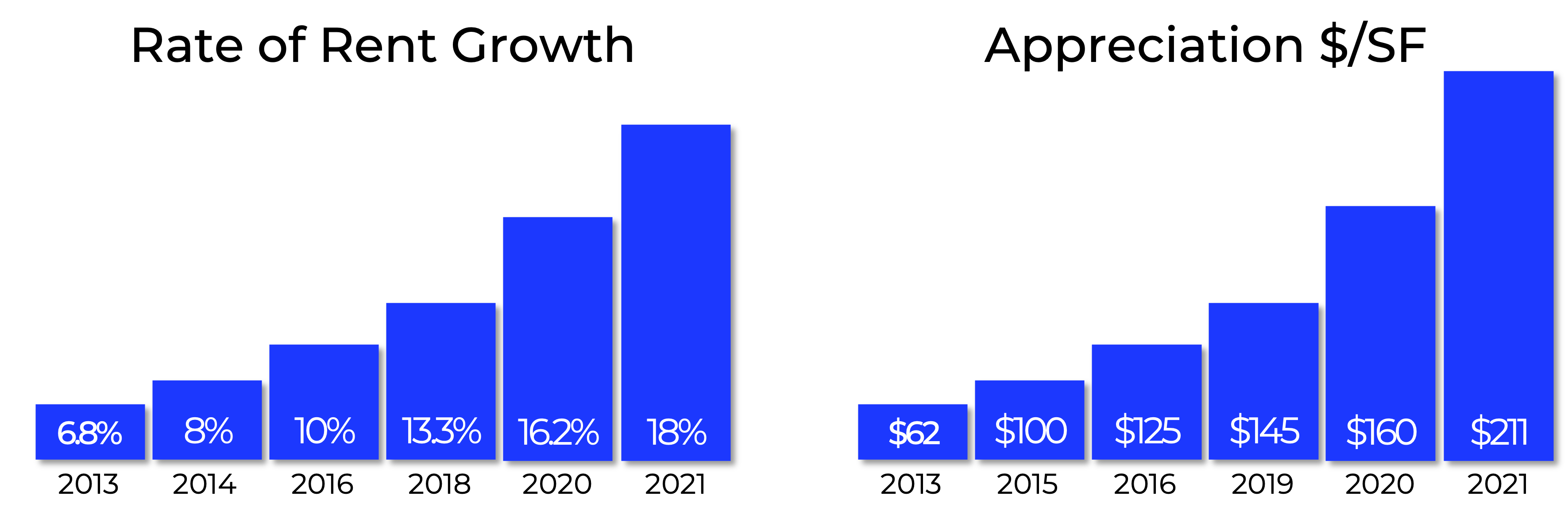
In 2021, rent growth was 18%. Appreciation was 32%. So, there are locations with sustained appreciation, but such locations are not common.
Eric, you will not buy an average property in an average location, so national averages mean little. You will buy a specific property in a specific location. Location is the most important investment decision; it is not the property. You need to choose a location where the pre-COVID rent growth and appreciation were greater than the current inflation rate. If you want a dependable passive income, the location must meet three characteristics:
To consistently acquire dependable passive income streams through real estate you need a process. Not gurus or "secrets". Below is the process that we developed and followed to deliver 400+ dependable passive income properties.
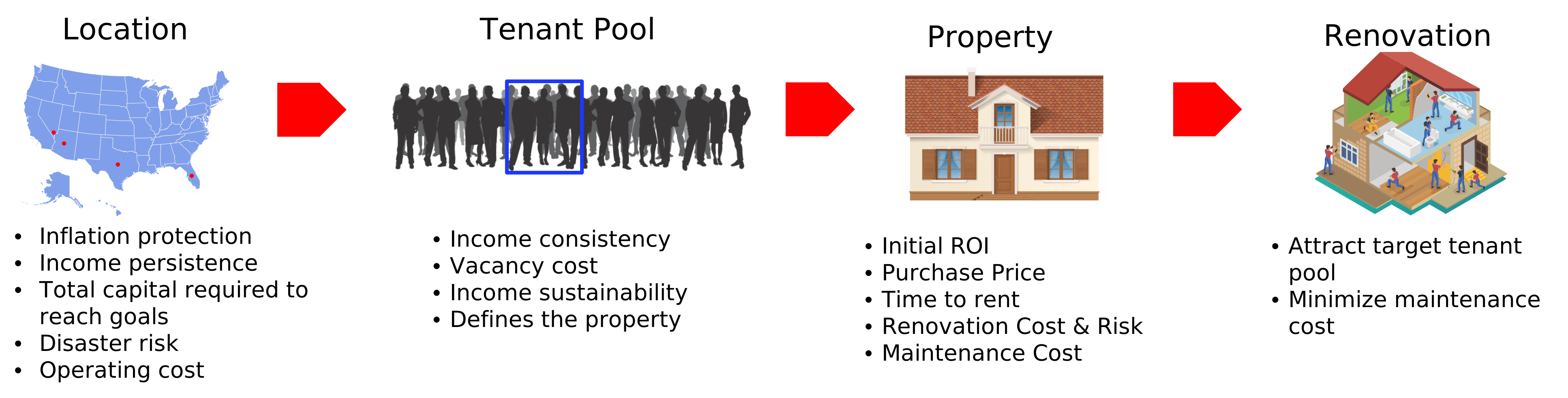
The process is straightforward. First, choose your location, which defines the long term characteristics, including:
Next, choose a tenant pool with a high concentration of what I call good tenants.
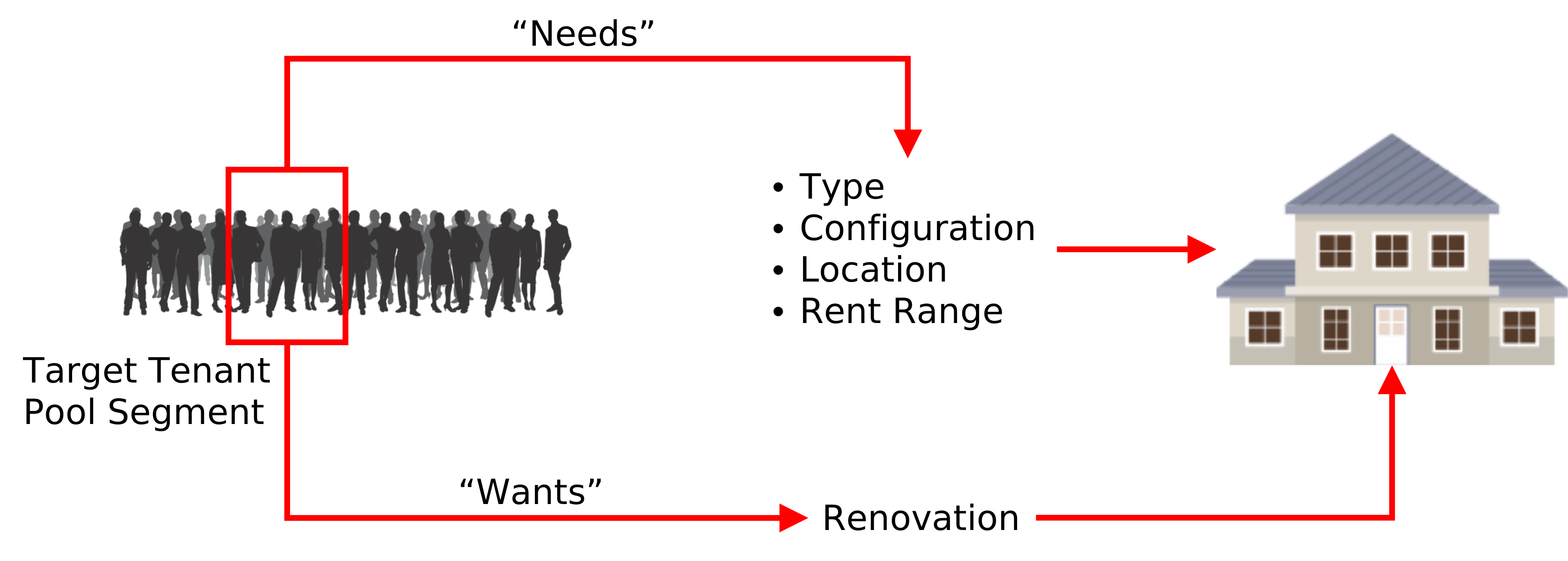
Once you choose a tenant pool, select properties that your target tenant pool is ready, willing, and able to rent, the process is illustrated below. Your tenant pool defines the property type, location, configuration, and rent range; you do not choose the property type; your target tenant pool defines the property type and everything else.
In summary, you can buy properties that will outpace inflation, but not just any location or properties will do.
Hi Eric, I think the bigger question we keep coming back to is whether "inflation adjustment" actually adjusts for the full extent of monetary inflation. (Spoiler alert: It probably doesn't :-)
Further, homes in the areas with the greatest "appreciation" may often be the areas that are likely see the greatest declines in downturns, making such "appreciation" from their bubble dynamics relatively short lived.
Add to this that any renovation which leads to an increase in home value cannot necessarily be considered "appreciation". If you spent $30k to renovate a bathroom and it raised the home's value by $20k, it would be silly to call that "appreciation"—even if it was a wise choice from a cashflow, debt leverage or tax perspective.
In real terms, buildings and homes themselves are certainly depreciating assets. This is why they are and always have been treated as such in the tax code.
That said, the value of the property on which the building or home is built could become more desirable for a variety of reasons, thereby increasing its market price.
But strictly speaking, that's not the building or home itself "appreciating". The structure itself is always depreciating. It's the land on which it's built potentially becoming more desirable. (Which to your credit you do seem to acknowledge!)
However, this is not even to mention the larger point: A good portion of any nominal price "appreciation" may very well be from monetary inflation in excess of the small portion of monetary inflation that is captured by the CPI.
In real terms, it could very well be that the real estate that appears to "depreciate" or remain flat in so-called "inflation adjusted" terms is actually depreciating more rapidly in real terms, while in some cases, homes that appear to "appreciate" in so-called "inflation adjusted" terms are remaining flat or even depreciating slightly.
A whole bunch of charts and graphs to that effect have been shared in this very thread! On average, home prices are indeed lower today than they were decades ago in real terms. (Which to your credit you do seem to acknowledge as well!) And those few areas where this is not the case often have low to no cash flows, and are the most likely to be in bubble territory that will soon deflate in real terms.
With all that said, there are still very good deals to be had out there! Real estate can be a very good thing to invest in. But it's wise to be skeptical of "appreciation" for these reasons, and there's reasons that for long term investing, cash flow is king :-) (To your credit you seem to acknowledge this too!)
At the end of the day, getting into chasing appreciation can be very misleading, and often involves investing by looking in the rear view mirror, often trying to make sense of a property that doesn't actually make sense when you consider it from a nuts and bolts profit-and-loss perspective. In many cases, the properties that appreciate the least can even be the best investments if your idea is to buy and hold and collect yield!
It's also worth remembering that even if you do have real appreciation, you have to sell to realize it :-) So goodbye cashflows. (Extracting equity by taking on more debt isn't the same thing as realizing a profit... Thought it can certainly be wise in some cases.)
Anyway I hope some of that makes sense! I'm probably rambling on too much in this thread. It's just a topic I've become a bit too interested in as of late!
People write a lot of articles that cite a lot of stats from economists and things like that. I don't get into any of it. I don't pay attention to the stock market or the index this or that.
I make smart decisions in the real estate industry because I'm a friggin' real estate ninja. I don't know jack about half the crap folks who read all these economist's articles are talking about, but yet, I've made millions, because I focus on what I know and what I can control. I ignore the rest.
Hi Eric, I think the bigger question we keep coming back to is whether "inflation adjustment" actually adjusts for the full extent of monetary inflation. (Spoiler alert: It probably doesn't :-)
Further, homes in the areas with the greatest "appreciation" may often be the areas that are likely see the greatest declines in downturns, making such "appreciation" from their bubble dynamics relatively short lived.
Add to this that any renovation which leads to an increase in home value cannot necessarily be considered "appreciation". If you spent $30k to renovate a bathroom and it raised the home's value by $20k, it would be silly to call that "appreciation"—even if it was a wise choice from a cashflow, debt leverage or tax perspective.
In real terms, buildings and homes themselves are certainly depreciating assets. This is why they are and always have been treated as such in the tax code.
That said, the value of the property on which the building or home is built could become more desirable for a variety of reasons, thereby increasing its market price.
But strictly speaking, that's not the building or home itself "appreciating". The structure itself is always depreciating. It's the land on which it's built potentially becoming more desirable. (Which to your credit you do seem to acknowledge!)
However, this is not even to mention the larger point: A good portion of any nominal price "appreciation" may very well be from monetary inflation in excess of the small portion of monetary inflation that is captured by the CPI.
In real terms, it could very well be that the real estate that appears to "depreciate" or remain flat in so-called "inflation adjusted" terms is actually depreciating more rapidly in real terms, while in some cases, homes that appear to "appreciate" in so-called "inflation adjusted" terms are remaining flat or even depreciating slightly.
A whole bunch of charts and graphs to that effect have been shared in this very thread! On average, home prices are indeed lower today than they were decades ago in real terms. (Which to your credit you do seem to acknowledge as well!) And those few areas where this is not the case often have low to no cash flows, and are the most likely to be in bubble territory that will soon deflate in real terms.
With all that said, there are still very good deals to be had out there! Real estate can be a very good thing to invest in. But it's wise to be skeptical of "appreciation" for these reasons, and there's reasons that for long term investing, cash flow is king :-) (To your credit you seem to acknowledge this too!)
At the end of the day, getting into chasing appreciation can be very misleading, and often involves investing by looking in the rear view mirror, often trying to make sense of a property that doesn't actually make sense when you consider it from a nuts and bolts profit-and-loss perspective. In many cases, the properties that appreciate the least can even be the best investments if your idea is to buy and hold and collect yield!
It's also worth remembering that even if you do have real appreciation, you have to sell to realize it :-) So goodbye cashflows. (Extracting equity by taking on more debt isn't the same thing as realizing a profit... Thought it can certainly be wise in some cases.)
Anyway I hope some of that makes sense! I'm probably rambling on too much in this thread. It's just a topic I've become a bit too interested in as of late!
"Real terms" has nothing to do with your definition/explanation/speech. It is, and always has been, a result of the spread between cost to the REI and income...sometimes called profit and cash flow. It's a very simple formula for either with the understanding what the cost to the REI is for both "spreads". The cost to the REI doesn't include anything but cash out of the REI pocket...that's it. COP can be controlled by the REI based on decisions they make to reduce that COP.
Deals are not found, they are made from opportunities, and are based on the same two things, regardless of anything else:
1 - Cash out of pocket
2 - The terms where the rest of the "total" cost is paid for by someone/something else.
One stated benefit of investing in real estate is price appreciation. However, if you look at inflation adjusted real estate prices for the most part there isn't much appreciation. There are specific points in time like 2006 (we know what followed that) and right now when real estate exceeds inflation adjusted prices. However, over the long term it doesn't really appear that real estate appreciates much beyond inflation. Is real estate appreciation a myth?
Disagree, appreciation on some areas like mine have been over 15%/year, the last few years.
Now, cost of living have gone up, same rate at %15/year?
Well on the other hand, tell that to my County Tax Assessor Collector in San Antonio Texas. I hope they believe is a fake appreciation myth... Which is not. If you have access to the MLS and do a Market Comparable Analysis (CMAs) for a property, you will see, it is REAL!
Now wait for a "depreciation" on property assessed value. It will just not happen. Everyone will have to protest the taxes to get a turnout, which is very unlikely. Taxes are baes on %, and that's the market say, the % still the same.
Appreciation or "inflation" as you called it, its how the market changes, but for some (aka Government), its just a positive number, never negative.
@Eric James
There will be exceptions for everything - but look at how most millionaires get to where they are at?
Through real estate. If I buy a home for $250,000 and put $50,000 down. Let’s say I get zero cash flow and rent is paying my taxes and all my expenses. If the house was appreciating at 4% and inflation is doing the same. The home is appreciating $10k+ per year and inflation is $2,000 on my $50k.
Also the renter is paying my principal down for me as well…