How is this investment strategy?

How is this investment strategy?

Member since 2019 · 15 posts · 3 votes

I am looking at getting into multi unit investing. Have no prior real estate experience but have pretty extensive business experience, managing cash flow, people etc. 

I currently have a portfolio of businesses that are providing more than enough steady cash-flow for my personal expenses and investment activity. Therefore any positive cashflow that I am able to generate through real-estate deals will be leveraged to acquire more property and build a portfolio. I'm relatively young (38) so im looking for a long term strategy and not interested in speculative deals. 

     -I live in DC but looking to invest in OH, TN, FL, NC, or TN

     -I have about $500k of my own cash to invest (Another $200k per year from my business interests)

    1. -My business interests are somewhat passive so I have time to dedicate and invest into real estate 
    2. -Looking for 12+ unit buildings
    3. -light value add opportunity but no major rehab for first 2-3 years of investing
    4. -Will be looking to put down 25%-30% in cash/ commercial loan for the rest
    5. -Increase cashflow with each acquisition to pull out most of down payment within 36 months 
    6. -Acquire more real estate and repeat

    I'm currently spending time educating myself and looking over deals on loopnet and getting in touch with real estate agents in the markets mentioned above for networking purposes but i'm unsure how quickly I would be willing and able to go after a deal should the numbers make sense. 

    1. Is it wise for a novice real estate investor to look at markets over 6 hours away? 

    2. How much of a factor is my inexperience in real estate when lenders analyze my risk 

    3. What are the biggest pitfalls and lessons to learn for beginners? 

    4. Does my overall strategy make sense?

    Any help or criticism is greatly appreciated :)

      0Reply
      57 views

      Most Popular Reply

      Investor · Washington, DC · Member since 2017 · 198 posts · 323 votes
      6y

      I would still choose the Washington DC trend line over the Columbus one:

      Plus, in DC our largest employer is the federal government. The government isn't going out of business or moving to another city anytime soon. Amazon is coming. 

      DC is the place to be and if you are already here and you can make DC cash flow, then I don't know why anyone would invest out of state (or out of The District in this case).

      See this reply in the discussion

      21 Replies

      Jump to latestLatest
      • Joe VilleneuvePro Member
        Plymouth, MI · Member since 2013 · 13k+ posts · 19k+ votes
        6y

        Well, I guess we can answer that question when you fill us in on what your strategy actually is.

      • Member since 2019 · 15 posts · 3 votes
        6y
        Originally posted by @Joe Villeneuve:

        Well, I guess we can answer that question when you fill us in on what your strategy actually is.

        Purchase 12+ unit properties within markets mentioned above.

        light value add opportunities w/ 25% down. Increase rents, Refinance, repeat.

        Is that not a strategy? 

      • Joe VilleneuvePro Member
        Plymouth, MI · Member since 2013 · 13k+ posts · 19k+ votes
        6y

        Incomplete:

        1  Where exactly in these markets

        2 - Exactly what will your rehab budget be?

        3 - Why 25% down?

        4 - Increase rents from what to what?

        5 - Refi based on what values at purchase and refi?

        6 - Repeat what?  Not enough of the blanks filled in to know what you will be repeating.

        Why are these unanswered questions important?  You can't answer your main question without knowing the answers to mine, because without my answers...how will you know if it will work or not?

      • Member since 2019 · 15 posts · 3 votes
        6y
        Originally posted by @Joe Villeneuve:

        Incomplete:

        1  Where exactly in these markets

        2 - Exactly what will your rehab budget be?

        3 - Why 25% down?

        4 - Increase rents from what to what?

        5 - Refi based on what values at purchase and refi?

        6 - Repeat what?  Not enough of the blanks filled in to know what you will be repeating.

        Why are these unanswered questions important?  You can't answer your main question without knowing the answers to mine, because without my answers...how will you know if it will work or not?

        Great questions. I’m in the process of educating myself to be able to answer those questions to myself but I’m not currently able to answer them yet. I guess what I’m asking is if my general strategy 

        1. if Cincinnati is a market I target, is it feasible and advisable for a beginner to invest outside of his home market? 

        2. Depending on property and deal but I’m  looking to acquire already cash flowing properties that have some value add potential. 

        3. 25% down because that is the minimum required for commercial loans ( if I’m wrong please educate me) 

        4. Again, depending on deal.

        Better question, if you were starting over and you have approx $500k to invest, how would you go about it? 

      • Joe VilleneuvePro Member
        Plymouth, MI · Member since 2013 · 13k+ posts · 19k+ votes
        6y
        Originally posted by @Doug Sah:
        Originally posted by @Joe Villeneuve:

        Incomplete:

        1  Where exactly in these markets

        2 - Exactly what will your rehab budget be?

        3 - Why 25% down?

        4 - Increase rents from what to what?

        5 - Refi based on what values at purchase and refi?

        6 - Repeat what?  Not enough of the blanks filled in to know what you will be repeating.

        Why are these unanswered questions important?  You can't answer your main question without knowing the answers to mine, because without my answers...how will you know if it will work or not?

        Great questions. I’m in the process of educating myself to be able to answer those questions to myself but I’m not currently able to answer them yet. I guess what I’m asking is if my general strategy 

        1. if Cincinnati is a market I target, is it feasible and advisable for a beginner to invest outside of his home market? 

        2. Depending on property and deal but I’m  looking to acquire already cash flowing properties that have some value add potential. 

        3. 25% down because that is the minimum required for commercial loans ( if I’m wrong please educate me) 

        4. Again, depending on deal.

        Better question, if you were starting over and you have approx $500k to invest, how would you go about it? 

        If I was starting from scratch (w/500k...I guess that's a lot of scratch)m here's what I would do:

        1 - Learn how to analyze Markets to find the Micro Markets within the larger general markets

        2 - Learn how money works

        3 - Learn how to develop a plan based on specific financial goals

        4 - Learn how the first 3 above must work together as one to reach success

        5 - Apply the above within specific micro markets that whose profiles match the criteria required at the specific timelines within the Plan

        6 - Develop my Power Team that includes:  Accountant, rehabers, lenders, partners, property managers, and a series of RE Agents (NEVER just one)

        7 - Now, analyze the individual properties within the Micro Markets found in Step #5, making sure NOT to negotiate against myself

        6 - Follow the  2 Golden Rules:  Never,EVER, spend your seed money (that 500k).  Use it to infinity, but NEVER spend it.

        7 - Learn the meaning of this series of numbers: 1073741824, memorize that string, and apply it to every decision you make in your REI.

        8 - Flip your seed money, take the profits and add them to your seed money until you reach the number needed at the time as defined in your Plan.

        9 - Continue to flip your seed money (use it), but now spend your profits to eliminate personal debt, and to buy cash flow properties to cover monthly bills.

        10 - Repeat 5 - 9 until goals are achieved in your plan, then...

        ...start another Plan with a different set of goals...using the seed money that you still haven't spent from the first Plan.

      • Member since 2019 · 15 posts · 3 votes
        6y
        Originally posted by @Joe Villeneuve:
        Originally posted by @Doug Sah:
        Originally posted by @Joe Villeneuve:

        Incomplete:

        1  Where exactly in these markets

        2 - Exactly what will your rehab budget be?

        3 - Why 25% down?

        4 - Increase rents from what to what?

        5 - Refi based on what values at purchase and refi?

        6 - Repeat what?  Not enough of the blanks filled in to know what you will be repeating.

        Why are these unanswered questions important?  You can't answer your main question without knowing the answers to mine, because without my answers...how will you know if it will work or not?

        Great questions. I’m in the process of educating myself to be able to answer those questions to myself but I’m not currently able to answer them yet. I guess what I’m asking is if my general strategy 

        1. if Cincinnati is a market I target, is it feasible and advisable for a beginner to invest outside of his home market? 

        2. Depending on property and deal but I’m  looking to acquire already cash flowing properties that have some value add potential. 

        3. 25% down because that is the minimum required for commercial loans ( if I’m wrong please educate me) 

        4. Again, depending on deal.

        Better question, if you were starting over and you have approx $500k to invest, how would you go about it? 

        If I was starting from scratch (w/500k...I guess that's a lot of scratch)m here's what I would do:

        1 - Learn how to analyze Markets to find the Micro Markets within the larger general markets

        2 - Learn how money works

        3 - Learn how to develop a plan based on specific financial goals

        4 - Learn how the first 3 above must work together as one to reach success

        5 - Apply the above within specific micro markets that whose profiles match the criteria required at the specific timelines within the Plan

        6 - Develop my Power Team that includes:  Accountant, rehabers, lenders, partners, property managers, and a series of RE Agents (NEVER just one)

        7 - Now, analyze the individual properties within the Micro Markets found in Step #5, making sure NOT to negotiate against myself

        6 - Follow the  2 Golden Rules:  Never,EVER, spend your seed money (that 500k).  Use it to infinity, but NEVER spend it.

        7 - Learn the meaning of this series of numbers: 1073741824, memorize that string, and apply it to every decision you make in your REI.

        8 - Flip your seed money, take the profits and add them to your seed money until you reach the number needed at the time as defined in your Plan.

        9 - Continue to flip your seed money (use it), but now spend your profits to eliminate personal debt, and to buy cash flow properties to cover monthly bills.

        10 - Repeat 5 - 9 until goals are achieved in your plan, then...

        ...start another Plan with a different set of goals...using the seed money that you still haven't spent from the first Plan.

         Joe, 

        thanks a ton. I’m really curious about number 6 and 7. 

        6. Can you elaborate on this please. I’ve read you mention this before in other threads and I’M very curious to understand your break down. 

        7. I’m totally lost here. What do these numbers represent? 

      • Joe VilleneuvePro Member
        Plymouth, MI · Member since 2013 · 13k+ posts · 19k+ votes
        6y
        Originally posted by @Doug Sah:
        Originally posted by @Joe Villeneuve:
        Originally posted by @Doug Sah:
        Originally posted by @Joe Villeneuve:

        Incomplete:

        1  Where exactly in these markets

        2 - Exactly what will your rehab budget be?

        3 - Why 25% down?

        4 - Increase rents from what to what?

        5 - Refi based on what values at purchase and refi?

        6 - Repeat what?  Not enough of the blanks filled in to know what you will be repeating.

        Why are these unanswered questions important?  You can't answer your main question without knowing the answers to mine, because without my answers...how will you know if it will work or not?

        Great questions. I’m in the process of educating myself to be able to answer those questions to myself but I’m not currently able to answer them yet. I guess what I’m asking is if my general strategy 

        1. if Cincinnati is a market I target, is it feasible and advisable for a beginner to invest outside of his home market? 

        2. Depending on property and deal but I’m  looking to acquire already cash flowing properties that have some value add potential. 

        3. 25% down because that is the minimum required for commercial loans ( if I’m wrong please educate me) 

        4. Again, depending on deal.

        Better question, if you were starting over and you have approx $500k to invest, how would you go about it? 

        If I was starting from scratch (w/500k...I guess that's a lot of scratch)m here's what I would do:

        1 - Learn how to analyze Markets to find the Micro Markets within the larger general markets

        2 - Learn how money works

        3 - Learn how to develop a plan based on specific financial goals

        4 - Learn how the first 3 above must work together as one to reach success

        5 - Apply the above within specific micro markets that whose profiles match the criteria required at the specific timelines within the Plan

        6 - Develop my Power Team that includes:  Accountant, rehabers, lenders, partners, property managers, and a series of RE Agents (NEVER just one)

        7 - Now, analyze the individual properties within the Micro Markets found in Step #5, making sure NOT to negotiate against myself

        6 - Follow the  2 Golden Rules:  Never,EVER, spend your seed money (that 500k).  Use it to infinity, but NEVER spend it.

        7 - Learn the meaning of this series of numbers: 1073741824, memorize that string, and apply it to every decision you make in your REI.

        8 - Flip your seed money, take the profits and add them to your seed money until you reach the number needed at the time as defined in your Plan.

        9 - Continue to flip your seed money (use it), but now spend your profits to eliminate personal debt, and to buy cash flow properties to cover monthly bills.

        10 - Repeat 5 - 9 until goals are achieved in your plan, then...

        ...start another Plan with a different set of goals...using the seed money that you still haven't spent from the first Plan.

         Joe, 

        thanks a ton. I’m really curious about number 6 and 7. 

        6. Can you elaborate on this please. I’ve read you mention this before in other threads and I’M very curious to understand your break down. 

        7. I’m totally lost here. What do these numbers represent? 

         Sure.  The full explanation is probably too long to try to explain here.  PM me if you're interested.

        6 - If you "spend" your money, you're getting only one ue out of it.  This means whatever the cost was, that cost is applied to that one use...and, you need to start all over again with a new source for new money.

        If you "use" your money, you're getting more than one use out of it.  This means whatever the initial cost was, it is spread out evenly between each use.  The more times you used these funds, the lower the cost per use...and, you should never need another source of funding...when combined with #7.

        7 - Einstein said that the greatest invention of the 20th century was compound interest.  What he said after that was more important.  He said, "those that understand it, will live off of those that don't".  The number sequence of 1073741824 comes from what Einstein said.  It is what connects his statement, to application of it.  For a better explanation...PM me.  The explanation is too lone to attempt to present here.

      • Real Estate Investor · Los Angeles, CA · Member since 2013 · 98 posts · 48 votes
        6y

        Doug, 

        I like your general strategy but would suggest you start with a deal that it's more local.   What part of DC do you live in?   I invest in LA and Cincinnati. I bought a 22 unit apartment in pleasant ridge,  Cincinnati and did a huge rehab on it.   It was very hard finding people that we'd could trust to help us. I realize if I hadn't learned from my local investments I would not have been able to handle it.   Right now what you need most is knowledge,  your other business surely took a lot of study to perfect, this one does too.  

      • Member since 2019 · 15 posts · 3 votes
        6y
        Originally posted by @Alma Mills:

        Doug, 

        I like your general strategy but would suggest you start with a deal that it's more local.   What part of DC do you live in?   I invest in LA and Cincinnati. I bought a 22 unit apartment in pleasant ridge,  Cincinnati and did a huge rehab on it.   It was very hard finding people that we'd could trust to help us. I realize if I hadn't learned from my local investments I would not have been able to handle it.   Right now what you need most is knowledge,  your other business surely took a lot of study to perfect, this one does too.  

         Good point. Only Issue is the prices in DC are through the roof and the competition is extremely stiff. 

        Would you recommend then maybe a turnkey property in another market? 

      • Investor · Washington, DC · Member since 2017 · 198 posts · 323 votes
        6y
        Originally posted by @Doug Sah:

        Good point. Only Issue is the prices in DC are through the roof and the competition is extremely stiff. 

        Would you recommend then maybe a turnkey property in another market? 

        I respectfully disagree, I don't feel like the competition in the DC market is overly "stiff." Over the last three years I have been able to pick up three B Class, 1% rule properties in DC, two of which were sitting on the MLS for months.

        In regards to high prices in DC, isn't that the trend that you want?  That means the market is appreciating, versus a $75,000 house in Ohio that will still be $75,000 in 5 years. That's like not wanting to buy a stock because the price keeps going up and it keeps hitting new highs, and instead wanting to buy the stock that is cheap because the share price is low because the share price hasn't moved up for years.  I would rather buy a $1,000,000 property in DC that I know is going to appreciate than a 2% rule property in Ohio that will never be a $1,000,000 property. 

        You have $500k, you can make it work here in DC.  With $500k you can buy 3 cash flowing DC rental properties in nice neighborhoods (no risky war zones or ghettos needed) and make about $8,000 a month in cash flow.  How do I know?  Because I did it.  Those last three DC properties that I mentioned above produce approximately $8,000 a month in cash flow. Cash to close on each of those three properties was about $150k to $200k, so with $500k you can definitely invest locally in DC and cash flow and get the benefits of appreciation which you aren't going to get by investing in Ohio.  


      • Member since 2019 · 15 posts · 3 votes
        6y
        Originally posted by @Ron Gallagher:
        Originally posted by @Doug Sah:

        Good point. Only Issue is the prices in DC are through the roof and the competition is extremely stiff. 

        Would you recommend then maybe a turnkey property in another market? 

        I respectfully disagree, I don't feel like the competition in the DC market is overly "stiff." Over the last three years I have been able to pick up three B Class, 1% rule properties in DC, two of which were sitting on the MLS for months.

        In regards to high prices in DC, isn't that the trend that you want?  That means the market is appreciating, versus a $75,000 house in Ohio that will still be $75,000 in 5 years. That's like not wanting to buy a stock because the price keeps going up and it keeps hitting new highs, and instead wanting to buy the stock that is cheap because the share price is low because the share price hasn't moved up for years.  I would rather buy a $1,000,000 property in DC that I know is going to appreciate than a 2% rule property in Ohio that will never be a $1,000,000 property. 

        You have $500k, you can make it work here in DC.  With $500k you can buy 3 cash flowing DC rental properties in nice neighborhoods (no risky war zones or ghettos needed) and make about $8,000 a month in cash flow.  How do I know?  Because I did it.  Those last three DC properties that I mentioned above produce approximately $8,000 a month in cash flow. Cash to close on each of those three properties was about $150k to $200k, so with $500k you can definitely invest locally in DC and cash flow and get the benefits of appreciation which you aren't going to get by investing in Ohio.  


        WOW.... I need to know how you were able to pick up 3 properties in DC with $8k a month cash flow with only $150-$200k DP each.Where these major rehab properties? 

        By high price, I meant price-rent ratio. Appreciation is great but but my primary investment objective is cashflow, and capital preservation. 

      • Russell BrazilBusiness Member
        Moderator
        Real Estate Agent · Washington, D.C. · Member since 2012 · 17k+ posts · 30k+ votes
        6y
        Originally posted by @Doug Sah:
        Originally posted by @Ron Gallagher:
        Originally posted by @Doug Sah:

        Good point. Only Issue is the prices in DC are through the roof and the competition is extremely stiff. 

        Would you recommend then maybe a turnkey property in another market? 

        I respectfully disagree, I don't feel like the competition in the DC market is overly "stiff." Over the last three years I have been able to pick up three B Class, 1% rule properties in DC, two of which were sitting on the MLS for months.

        In regards to high prices in DC, isn't that the trend that you want?  That means the market is appreciating, versus a $75,000 house in Ohio that will still be $75,000 in 5 years. That's like not wanting to buy a stock because the price keeps going up and it keeps hitting new highs, and instead wanting to buy the stock that is cheap because the share price is low because the share price hasn't moved up for years.  I would rather buy a $1,000,000 property in DC that I know is going to appreciate than a 2% rule property in Ohio that will never be a $1,000,000 property. 

        You have $500k, you can make it work here in DC.  With $500k you can buy 3 cash flowing DC rental properties in nice neighborhoods (no risky war zones or ghettos needed) and make about $8,000 a month in cash flow.  How do I know?  Because I did it.  Those last three DC properties that I mentioned above produce approximately $8,000 a month in cash flow. Cash to close on each of those three properties was about $150k to $200k, so with $500k you can definitely invest locally in DC and cash flow and get the benefits of appreciation which you aren't going to get by investing in Ohio.  


        WOW.... I need to know how you were able to pick up 3 properties in DC with $8k a month cash flow with only $150-$200k DP each.Where these major rehab properties? 

        By high price, I meant price-rent ratio. Appreciation is great but but my primary investment objective is cashflow, and capital preservation. 

        Cashflow and capital preservation are not two strategies that go hand in hand.  Yield in an asset are a function of the risk of that asset and market. So the higher cash flow properties/markets have much higher price volatility, which is the opposite of what you seek with a capital preservation strategy.

      • Member since 2019 · 15 posts · 3 votes
        6y
        Originally posted by @Russell Brazil:
        Originally posted by @Doug Sah:
        Originally posted by @Ron Gallagher:
        Originally posted by @Doug Sah:

        Good point. Only Issue is the prices in DC are through the roof and the competition is extremely stiff. 

        Would you recommend then maybe a turnkey property in another market? 

        I respectfully disagree, I don't feel like the competition in the DC market is overly "stiff." Over the last three years I have been able to pick up three B Class, 1% rule properties in DC, two of which were sitting on the MLS for months.

        In regards to high prices in DC, isn't that the trend that you want?  That means the market is appreciating, versus a $75,000 house in Ohio that will still be $75,000 in 5 years. That's like not wanting to buy a stock because the price keeps going up and it keeps hitting new highs, and instead wanting to buy the stock that is cheap because the share price is low because the share price hasn't moved up for years.  I would rather buy a $1,000,000 property in DC that I know is going to appreciate than a 2% rule property in Ohio that will never be a $1,000,000 property. 

        You have $500k, you can make it work here in DC.  With $500k you can buy 3 cash flowing DC rental properties in nice neighborhoods (no risky war zones or ghettos needed) and make about $8,000 a month in cash flow.  How do I know?  Because I did it.  Those last three DC properties that I mentioned above produce approximately $8,000 a month in cash flow. Cash to close on each of those three properties was about $150k to $200k, so with $500k you can definitely invest locally in DC and cash flow and get the benefits of appreciation which you aren't going to get by investing in Ohio.  


        WOW.... I need to know how you were able to pick up 3 properties in DC with $8k a month cash flow with only $150-$200k DP each.Where these major rehab properties? 

        By high price, I meant price-rent ratio. Appreciation is great but but my primary investment objective is cashflow, and capital preservation. 

        Cashflow and capital preservation are not two strategies that go hand in hand.  Yield in an asset are a function of the risk of that asset and market. So the higher cash flow properties/markets have much higher price volatility, which is the opposite of what you seek with a capital preservation strategy.

         Let me explain, I am generating positive cash flow through my business and looking to diversify by investing that capital into real estate to build a portfolio of positive cash flowing properties than can provide a steady return. 

        Since my objective is long term should i be thinking about appreciation more than cash flow?

      • Investor · Washington, DC · Member since 2017 · 198 posts · 323 votes
        6y
        Originally posted by @Doug Sah:

        WOW.... I need to know how you were able to pick up 3 properties in DC with $8k a month cash flow with only $150-$200k DP each.Where these major rehab properties? 

        I buy houses in Columbia Heights - Petworth area with as many bedrooms as possible (I'll turn a living room, a dining room with an egress window, basement rec room, a heated porch, etc. into bedrooms as well.) and rent by the room.  

        Actually these were all move-in ready properties or properties that had all the tenants living in the house already, so no rehab needed. In fact, if a property has been recently rehabbed I probably don't want it because the first floor will be open concept and all the walls will be gone so there's no living room or dining room left to turn into a bedroom. 

      • Real Estate Investor · Los Angeles, CA · Member since 2013 · 98 posts · 48 votes
        6y

        Doug,

        I know DC is expensive, so is LA but I have never had $500k cash to invest and have 3 properties in town. You can invest locally with that kind of money.  Don't invest in the most expensive parts of town.  Did you listen to the recent podcast from the other investor who buys in DC?  He buys places that he can add 2 bedrooms into the basement and then fixes them up and rents them for Section 8 tenants who pay $5600 a month.  Yes, purchase prices are higher in our markets but so are rents and you have more than enough to play the big boy game.  If your business income is high even better as the lender will like that. You could also try house hacking and live in a unit of a multifamily property.  That is what I do.  Or try going out into the suburbs of Maryland or Virginia where you can get less expensive properties.  Of course, if you are adamant about going out of state you need to find a property manager you can trust.  You can do turn key too but that means you really need to vet your turnkey company very thoroughly. 

        The reason I suggested house hacking is because they let you go in with lower down payments if they are 4 units or less from what I understand.  So if you go in with 10% down you could buy a $5,000,000 property.  I would not suggest it as you want to make sure your numbers work.

      • Rental Property Investor · RVA · Member since 2016 · 5k+ posts · 4k+ votes
        6y
        Originally posted by @Doug Sah:
        Originally posted by @Russell Brazil:
        Originally posted by @Doug Sah:
        Originally posted by @Ron Gallagher:
        Originally posted by @Doug Sah:

        Good point. Only Issue is the prices in DC are through the roof and the competition is extremely stiff. 

        Would you recommend then maybe a turnkey property in another market? 

        I respectfully disagree, I don't feel like the competition in the DC market is overly "stiff." Over the last three years I have been able to pick up three B Class, 1% rule properties in DC, two of which were sitting on the MLS for months.

        In regards to high prices in DC, isn't that the trend that you want?  That means the market is appreciating, versus a $75,000 house in Ohio that will still be $75,000 in 5 years. That's like not wanting to buy a stock because the price keeps going up and it keeps hitting new highs, and instead wanting to buy the stock that is cheap because the share price is low because the share price hasn't moved up for years.  I would rather buy a $1,000,000 property in DC that I know is going to appreciate than a 2% rule property in Ohio that will never be a $1,000,000 property. 

        You have $500k, you can make it work here in DC.  With $500k you can buy 3 cash flowing DC rental properties in nice neighborhoods (no risky war zones or ghettos needed) and make about $8,000 a month in cash flow.  How do I know?  Because I did it.  Those last three DC properties that I mentioned above produce approximately $8,000 a month in cash flow. Cash to close on each of those three properties was about $150k to $200k, so with $500k you can definitely invest locally in DC and cash flow and get the benefits of appreciation which you aren't going to get by investing in Ohio.  


        WOW.... I need to know how you were able to pick up 3 properties in DC with $8k a month cash flow with only $150-$200k DP each.Where these major rehab properties? 

        By high price, I meant price-rent ratio. Appreciation is great but but my primary investment objective is cashflow, and capital preservation. 

        Cashflow and capital preservation are not two strategies that go hand in hand.  Yield in an asset are a function of the risk of that asset and market. So the higher cash flow properties/markets have much higher price volatility, which is the opposite of what you seek with a capital preservation strategy.

         Let me explain, I am generating positive cash flow through my business and looking to diversify by investing that capital into real estate to build a portfolio of positive cash flowing properties than can provide a steady return. 

        Since my objective is long term should i be thinking about appreciation more than cash flow?

         I think not. You need cash flow in order to keep the properties. Banking on appreciation is what got people in trouble in 08-09. They had a ton of equity in their properties, with little to no cash flow or cash reserves. When the values dropped and the lending market dried up, they were back to zero. Cash flow first. 

        Use that cash flow to acquire more cash flowing properties!

      • Remington LymanBusiness Member
        Real Estate Agent · Columbus, OH · Member since 2017 · 6k+ posts · 7k+ votes
        6y

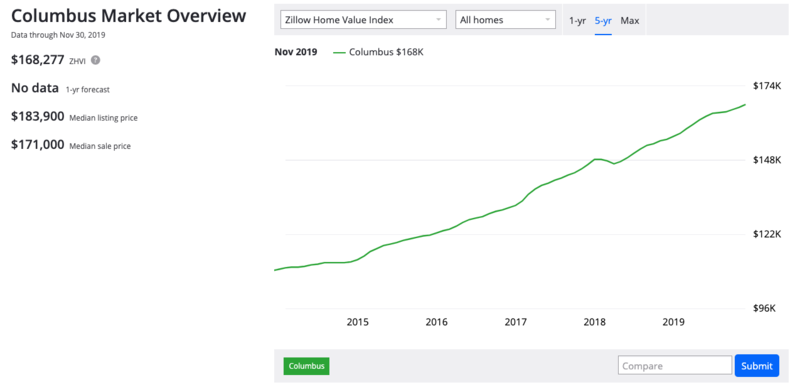
        @Ron Gallagher History begs to differ from your generalization on housing prices in Ohio. Columbus prices have experienced amazing appreciation. @Doug Sah You should look into my market

        This appreciation has strong fundamentals behind it as well. Rapid job growth and an increasing population.

      • Investor · Washington, DC · Member since 2017 · 198 posts · 323 votes
        6y

        I would still choose the Washington DC trend line over the Columbus one:

        Plus, in DC our largest employer is the federal government. The government isn't going out of business or moving to another city anytime soon. Amazon is coming. 

        DC is the place to be and if you are already here and you can make DC cash flow, then I don't know why anyone would invest out of state (or out of The District in this case).

      • Remington LymanBusiness Member
        Real Estate Agent · Columbus, OH · Member since 2017 · 6k+ posts · 7k+ votes
        6y

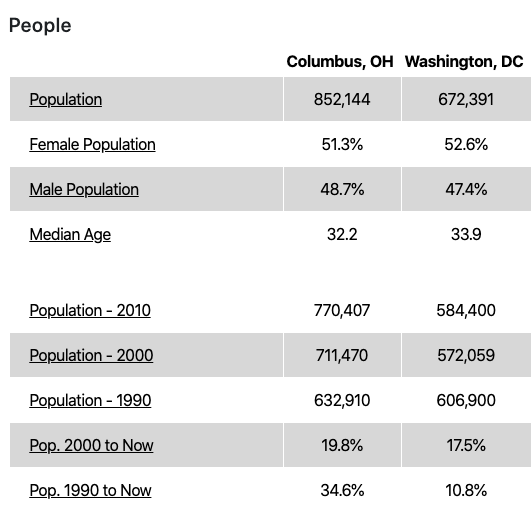
        @Ron Gallagher I would choose the population growth in Columbus, Ohio over the fluctuating population level in Washington, DC

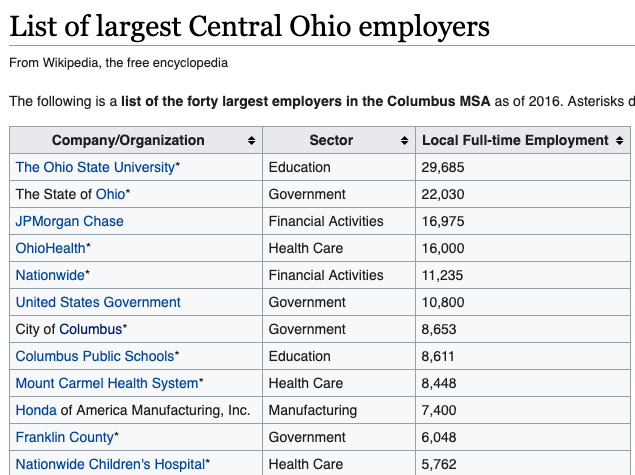
        Our largest employer is The Ohio State University, The State of Ohio and JPMorgan Chase. I would take them in a matchup against our federal government any day!

        Amazon, Facebook, and now Google are already here!

        ://www.dispatch.com/business/20191103/google-joins-new-albany-high-tech-crowd-with-600-million-data-

      • Real Estate Agent · Cincinnati, OH · Member since 2014 · 170 posts · 102 votes
        6y

        @Doug Sah given that your current business are generating good cashflow, are you looking to dive head-fist into a new investing arena and start from scratch with education and networking? Or are you just looking to diversify a portfolio that's already performing for you? If it's the latter, why not looking into more hassle-free or even passive REI options? The tax advantages and long-term cashflow are still there, and there's much less of a learning curve.

      • Member since 2019 · 15 posts · 3 votes
        6y
        Originally posted by @Slocomb Reed:

        @Doug Sah given that your current business are generating good cashflow, are you looking to dive head-fist into a new investing arena and start from scratch with education and networking? Or are you just looking to diversify a portfolio that's already performing for you? If it's the latter, why not looking into more hassle-free or even passive REI options? The tax advantages and long-term cashflow are still there, and there's much less of a learning curve.

        Im still relatively young and my current business has a strong organizational structure that does not need my presence so I am looking to dive in head first and learn REI with a long term investment strategy (20 years and more)

      Join the conversationCreate a free account to reply, vote on answers and follow this thread.