How you can profit from a Big Mortgage

How you can profit from a Big Mortgage

Specialist · Honolulu, HI · Member since 2014 · 1k+ posts · 1k+ votes

In light of all the recent threads about COVID-19, worrying about tenants not being able to pay rent, legislation that seems to screw over landlords month after month, and ethical dilemmas about where it is our obligation as landlords (or God's children) to cover the bills of tenants because of (fill in the blank)

Cash flow is for poor investors or investors that are poor (Apologize in advance to the BP / GRE / Turnkey advertisers)

Let me introduce to you a concept that is not often talk about, and probably frowned upon over the last 11 year bull market:

Big A** Mortgage (BAM)

Things most investors foolishly ignore..

  1. - Historic rent growth
  2. - Historic appreciation rate.
  3. - NOI per square foot
  4. - Operating expenses per sf
  5. - Capex per sf

Cash flow is for poor investors or investors that are poor.

If you need or hoped for cash flow to pay your cable bill then you probably should not be investing in real estate. The only reason I'm not cash flowing is because of a BAM that I am paying down because I am in a high appreciation market vs. a market where the only reason I may get cash flow is because the prices are so cheap because sellers are trying to unload unprofitable properties, this is by design.

So-called cash flow gets eaten up by CapEx and by pesky critters like the coronavirus. EVERY. SINGLE. TIME. I know that "cash flow" has been shoved down our throats because it makes money for advertisers and those companies selling it.

Its time to wake up and start thinking like the big boys (family offices, hedge funds, and billionaires). They are buying 3.5 caps in NY, London, HK, LA, and SF.. FOR A REASON. That reason is not the dream of cash flow.

7Reply
477 views

Most Popular Reply

Joe VilleneuvePro Member
Plymouth, MI · Member since 2013 · 13k+ posts · 19k+ votes
6y

So, to summarize your long winded whining, Cash Flow is a bad reason/way to invest because:

1 - You have chosen a market to invest in, that has poor cash flow
2 - Nobody can successfully cash flow because you can't do it in your market of choice.

See this reply in the discussion

117 Replies

Jump to latestLatest
  • Jay HinrichsBusiness Member
    Real Estate Consultant · Summerlin, NV · Member since 2014 · 45k+ posts · 66k+ votes
    6y
    Originally posted by @Calvin Thomas:
    Originally posted by @Steve Vaughan:
    Originally posted by @Calvin Thomas:
    Originally posted by @Steve Vaughan:

    The way to profit from a big a** mortgage is to be the mortgagee. 

    I'm offering no appraisal requirement or lenders insurance ($7000), no origination, doc prep, underwriting fees ($6000) a 30 yr term with no 5yr calls.  And I won't even ask him to submit his financials to me every year.

    But you're right.  All loans are fixed forever below 4% and I am screwing him over.  Hopefully the committee that has the right to call your loan in 5 years won't. 

    He must have really bad credit. Your fees and your rates are beyond screwing. Must be a real wiz you loaned money too. 

    Apples to Volkswagens  trying to compare rates of a seller carry back private mortgage and a new origination from a bank or professional lender. private mortgages are generally written with higher interest rates. 

  • Jay HinrichsBusiness Member
    Real Estate Consultant · Summerlin, NV · Member since 2014 · 45k+ posts · 66k+ votes
    6y
    Originally posted by @Andrey Y.:
    Originally posted by @John Collins:
    Originally posted by @Andrey Y.:

     I am actually cash flowing AND profiting in Hawaii specifically because rental income growth goes hand in hand with appreciation.  I would STILL profit even if my rentals were unoccupied. You cannot say the same thing.

    The reason I can cover missed rent payments is because I focus on profitable markets, not to be confused with "cash flow" markets on paper.

    What the hell are you talking about? You can cash flow without rental income? At what price point, what mortgage did you take out and how much interest are you paying on it? Simple math is all I ask for.  

     Very simple example. An investor owns a $800K home in a city in California. They earn $60K per year appreciation over the long term (which is $5K per month), which the Turnkey operators will tell you you should accept a $250 per month "cash flow", more than half of which will go to fixing up your boiler, or roof down the line, while the property value doesn't even keep up with inflation.

    Do you think @Account Closed @Matt R. @Jay Hinrichs @Amit M. (investors who invest for PROFIT) are worried about their tenant not making the April and May mortgage payments? Because all of the people I see worried on all the threads popping up, are not invested in profitable markets. They are invested for "cash flow" because that is what they have been hearing and reading about for the last 10 years.

    This is intended to teach, so we can all learn from something like this. At the end of the day, we are all trying to become better investors. Leave the advertising to those who are trying to sell you something. 

    A lot of this is simply playing the cards your dealt.. when I was starting in the industry in the mid 70s I lived in the SF bay area so that's were we invested Northern CA.. the thought of going across country to buy a rental was not contemplated..  It was the only thing we knew. And as luck would have it the SF Bay area has seen some pretty dramatic appreciation over the decades coming out of the 70s prior to that prices were no different than almost any other part of the country and maybe lower than many..  You also have investing philosophies at play you have the refi till you die have no real equity in any property no matter were it is thought process.. then you have other investors who are far more conservative and don't want debt.. Its personal choice at that point.  

    lastly its hard to time the market but there is no denying when you enter and when you exit directly correlates with your success.

    The bigger issue I see as of today is the threads of Lenders pulling out of financing rentals either raising the bar or freezing all together.. Freezing is what caused much of the melt down in the so called Cash flow markets in 07 to 2011.. you start to have markets that can only be traded in for cash and your not going to have price appreciation your going to have prices go down.. At least that's what everyone saw happened in the GFC..  I Mean you could buy homes in Detroit for 10 bucks.. you could buy new construction in Fort Myers at Sherriff sales for under 50k.. 4 plex's in AZ were selling under 100k that were sold 5 years earlier for 350k..  

    I for one am all for partaking if deals come up.. its the business we are in.. But I certainly do not want to see a repeat of the GFC mortgage market.. 

  • Carl FischerPro Member
    Rental Property Investor · Ambler, PA · Member since 2015 · 2k+ posts · 1k+ votes
    6y

    @John Teachout

    Positive cash flow is good. Negative cash flow not so much.

    BAMs are also good today because you will be paying back your loan with less valuable money. The dollar today will have more buying power than tomorrows dólar or the 2040 dollars. Dumping $2T in the country debt diluted the dollar and could be considered manipulation of our currency.

    BAMs are a play in the currency market while tenants make your payments for you.

    Borrowing as much as you can at a low rate should be a great move at this time-it may make you thrive not just survive. Think about it.

  • Specialist · Honolulu, HI · Member since 2014 · 1k+ posts · 1k+ votes
    6y
    Originally posted by @John Collins:
    Originally posted by @Andrey Y.:
    Originally posted by @John Collins:
    Originally posted by @Andrey Y.:

     I am actually cash flowing AND profiting in Hawaii specifically because rental income growth goes hand in hand with appreciation.  I would STILL profit even if my rentals were unoccupied. You cannot say the same thing.

    The reason I can cover missed rent payments is because I focus on profitable markets, not to be confused with "cash flow" markets on paper.

    What the hell are you talking about? You can cash flow without rental income? At what price point, what mortgage did you take out and how much interest are you paying on it? Simple math is all I ask for.  

     Very simple example. An investor owns a $800K home in a city in California. They earn $60K per year appreciation over the long term (which is $5K per month), which the Turnkey operators will tell you you should accept a $250 per month "cash flow", more than half of which will go to fixing up your boiler, or roof down the line, while the property value doesn't even keep up with inflation.

    Do you think @Account Closed @Amit M. (investors who invest for PROFIT) are worried about their tenant not making the April and May mortgage payments? Because all of the people I see worried on all the threads popping up, are not invested in profitable markets. They are invested for "cash flow" because that is what they have been hearing and reading about for the last 10 years.

    This is intended to teach, so we can all learn from something like this. At the end of the day, we are all trying to become better investors. Leave the advertising to those who are trying to sell you something. 

    Lol, yes... if everyone had Kushmer and Trump's parents we could all play that game but the majority of people need to stay afloat while being landlords. Specifically while starting out, which is people on BP. They don't all cruise out to a cushy 500k a year job at a law firm between collecting rent checks.

    You can't talk big before you have the means to do so. 

    The $60k/yr appreciation is flat out incorrect. Capital gains taxes, erosion of the property ,depreciation and a cap all cut into it. I have followed homes in Van Nuys, Burbank, Studio City (well, much more expensive there) in that price range and followed them over the past 13...14 years. They've hit a ceiling and will succumb to sprawl as well as new builds after a certain point. 

    You can have artifically inflated markets like 2011-2019 but really, there is a cap and it's not infinite. No one is earning 60k/yr in appreciation on a 800k house in a neighborhood like Burbank with no tenants. 

     "The $60k/yr appreciation is flat out incorrect. Capital gains taxes, erosion of the property ,depreciation and a cap all cut into it."

    Really. Ok. So tell me, how does capital gains taxes, erosion, depreciation affect a "cash flow" property whose value doesn't even keep up with inflation? Lol you're making my point for me

  • Specialist · Honolulu, HI · Member since 2014 · 1k+ posts · 1k+ votes
    6y
    Originally posted by @Jay Hinrichs:
    Originally posted by @Andrey Y.:
    Originally posted by @John Collins:
    Originally posted by @Andrey Y.:

     I am actually cash flowing AND profiting in Hawaii specifically because rental income growth goes hand in hand with appreciation.  I would STILL profit even if my rentals were unoccupied. You cannot say the same thing.

    The reason I can cover missed rent payments is because I focus on profitable markets, not to be confused with "cash flow" markets on paper.

    What the hell are you talking about? You can cash flow without rental income? At what price point, what mortgage did you take out and how much interest are you paying on it? Simple math is all I ask for.  

     Very simple example. An investor owns a $800K home in a city in California. They earn $60K per year appreciation over the long term (which is $5K per month), which the Turnkey operators will tell you you should accept a $250 per month "cash flow", more than half of which will go to fixing up your boiler, or roof down the line, while the property value doesn't even keep up with inflation.

    Do you think @Account Closed @Matt R. @Jay Hinrichs @Amit M. (investors who invest for PROFIT) are worried about their tenant not making the April and May mortgage payments? Because all of the people I see worried on all the threads popping up, are not invested in profitable markets. They are invested for "cash flow" because that is what they have been hearing and reading about for the last 10 years.

    This is intended to teach, so we can all learn from something like this. At the end of the day, we are all trying to become better investors. Leave the advertising to those who are trying to sell you something. 

    A lot of this is simply playing the cards your dealt.. when I was starting in the industry in the mid 70s I lived in the SF bay area so that's were we invested Northern CA.. the thought of going across country to buy a rental was not contemplated..  It was the only thing we knew. And as luck would have it the SF Bay area has seen some pretty dramatic appreciation over the decades coming out of the 70s prior to that prices were no different than almost any other part of the country and maybe lower than many..  You also have investing philosophies at play you have the refi till you die have no real equity in any property no matter were it is thought process.. then you have other investors who are far more conservative and don't want debt.. Its personal choice at that point.  

    lastly its hard to time the market but there is no denying when you enter and when you exit directly correlates with your success.

    The bigger issue I see as of today is the threads of Lenders pulling out of financing rentals either raising the bar or freezing all together.. Freezing is what caused much of the melt down in the so called Cash flow markets in 07 to 2011.. you start to have markets that can only be traded in for cash and your not going to have price appreciation your going to have prices go down.. At least that's what everyone saw happened in the GFC..  I Mean you could buy homes in Detroit for 10 bucks.. you could buy new construction in Fort Myers at Sherriff sales for under 50k.. 4 plex's in AZ were selling under 100k that were sold 5 years earlier for 350k..  

    I for one am all for partaking if deals come up.. its the business we are in.. But I certainly do not want to see a repeat of the GFC mortgage market.. 

    Exactly. And many people would have you believe that appreciation is all accidental, speculation, and not predictable in any way. Those who say that either aren't paying attention or are trying to sell you something.

     Those of us who underwrite for profit (and not cash flow) aren't worried about tenants not covering our mortgage payment for 2 months so we can collect the "$200 cash flow! 9 cap!" who advertise here and all over blogs and podcasts.

    $200 cash flow - no it's not

    9% cap rate! - a high cap rate means a less desirable asset, don't brag about it lol

    I cant believe investors still fall for this with all the information we have.

  • Real Estate Agent · Santa Barbara, CA · Member since 2016 · 518 posts · 283 votes
    6y

    @John Collins I don’t know his specific scenario but my guess is that a portion of the refinance proceeds was set aside to be used as working capital that can be used to pay any deficits in earnings before taxes.

  • Investor · Boston, MA · Member since 2015 · 1k+ posts · 3k+ votes
    6y

    While I don't like @Andrey Y.'s either or mentality, he raises some great points about the things that most investors ignore. 

    I'm with @Natalie Schanne that both sides are correct, since both types of investing are viable strategies to meet one's goals. They can exist side by side, they aren't mutually exclusive. 

    The reality of the situation is that not everyone can't get a jumbo mortgage to take advantage of BAM. Most people on this site make between $50-$90k/yr so they pick a strategy that works for them. 

    At the start of this quarantine, I went off the rails with all the time I had and make this post that used some of BP's own data to look at what drive Total Returns (Appreciation+Cash Flow). Big takeaways, Cash Flow and Appreciation both contributed positively to total return, with Appreciation being a big larger. 

    The most negative contributor to Total Returns: High Rent to value ratios.  ie the 1% and 2% rule aren't all they are cracked up to be. 

    Like @Joseph Cacciapaglia said, looking at historical returns only can blind you to the realities of today, but it is better than nothing and a good place to start. 

    Plus, it proves, fairly conclusively, that investing for Cash Flow and Appreciation are both viable strategies  across the country. 

  • Rental Property Investor · Tucson, AZ · Member since 2019 · 173 posts · 87 votes
    6y

    @Andrey Y.

    And you'll never realize any gains until you sell. Why can't you have both cash flow and appreciation?? Your logic is ridiculous and there is no need to over analyze numbers down to per sqft.

  • Rental Property Investor · Fayetteville, NC · Member since 2014 · 884 posts · 670 votes
    6y
    Originally posted by @Andrey Y.:
    Originally posted by @John Collins:
    Originally posted by @Andrey Y.:

     I am actually cash flowing AND profiting in Hawaii specifically because rental income growth goes hand in hand with appreciation.  I would STILL profit even if my rentals were unoccupied. You cannot say the same thing.

    The reason I can cover missed rent payments is because I focus on profitable markets, not to be confused with "cash flow" markets on paper.

    What the hell are you talking about? You can cash flow without rental income? At what price point, what mortgage did you take out and how much interest are you paying on it? Simple math is all I ask for.  

     Very simple example. An investor owns a $800K home in a city in California. They earn $60K per year appreciation over the long term (which is $5K per month), which the Turnkey operators will tell you you should accept a $250 per month "cash flow", more than half of which will go to fixing up your boiler, or roof down the line, while the property value doesn't even keep up with inflation.

    Do you think @Account Closed @Amit M. (investors who invest for PROFIT) are worried about their tenant not making the April and May mortgage payments? Because all of the people I see worried on all the threads popping up, are not invested in profitable markets. They are invested for "cash flow" because that is what they have been hearing and reading about for the last 10 years.

    This is intended to teach, so we can all learn from something like this. At the end of the day, we are all trying to become better investors. Leave the advertising to those who are trying to sell you something. 

    This is total BS speculation. Homes in CA do not appreciate long term at the rate of $5,000/month. You are out of your mind if you think that is the normal rate of appreciation. You are the one that is going to get hammered when tenants cant afford to pay their high dollar rents. Also - you are WAY off base about cash flow rentals. Affordable housing is probably the #1 issue facing America today. There are 1000 Americans that are barely able to keep up and need affordable housing for every 1 American who can afford to live in a HCOL area. You can have your own opinion, but dont share it in public forums like its the gospel.

  • Jay HinrichsBusiness Member
    Real Estate Consultant · Summerlin, NV · Member since 2014 · 45k+ posts · 66k+ votes
    6y
    Originally posted by @Justin Tahilramani:
    Originally posted by @Andrey Y.:
    Originally posted by @John Collins:
    Originally posted by @Andrey Y.:

     I am actually cash flowing AND profiting in Hawaii specifically because rental income growth goes hand in hand with appreciation.  I would STILL profit even if my rentals were unoccupied. You cannot say the same thing.

    The reason I can cover missed rent payments is because I focus on profitable markets, not to be confused with "cash flow" markets on paper.

    What the hell are you talking about? You can cash flow without rental income? At what price point, what mortgage did you take out and how much interest are you paying on it? Simple math is all I ask for.  

     Very simple example. An investor owns a $800K home in a city in California. They earn $60K per year appreciation over the long term (which is $5K per month), which the Turnkey operators will tell you you should accept a $250 per month "cash flow", more than half of which will go to fixing up your boiler, or roof down the line, while the property value doesn't even keep up with inflation.

    Do you think @Account Closed @Matt R. @Jay Hinrichs @Amit M. (investors who invest for PROFIT) are worried about their tenant not making the April and May mortgage payments? Because all of the people I see worried on all the threads popping up, are not invested in profitable markets. They are invested for "cash flow" because that is what they have been hearing and reading about for the last 10 years.

    This is intended to teach, so we can all learn from something like this. At the end of the day, we are all trying to become better investors. Leave the advertising to those who are trying to sell you something. 

    This is total BS speculation. Homes in CA do not appreciate long term at the rate of $5,000/month. You are out of your mind if you think that is the normal rate of appreciation. You are the one that is going to get hammered when tenants cant afford to pay their high dollar rents. Also - you are WAY off base about cash flow rentals. Affordable housing is probably the #1 issue facing America today. There are 1000 Americans that are barely able to keep up and need affordable housing for every 1 American who can afford to live in a HCOL area. You can have your own opinion, but dont share it in public forums like its the gospel. 

    Well lets look at a real life example 684 Encina Grande Palo Alto CA  one of the highest cost per sq ft in the country .. I bought it in 85 for 180k  I think it peaked at 2.5 or a little better.. lets say in 2019  so in 35 years it went up 2.315 million.. and of course rents at what I paid would have by the mid 90s given me massive cash flow of 3k a month easy on that one house..   2.315/  35X12  =  420 months/ 2.315 = 5,511 per month of appreciation gains.. add in 3k a month for Positive NET NET NET cash flow for say 25 of those years or 300 months X 3,000 = 900,000 in positive cash flow over that time.  for a grand total of 3.215.000 gain on a property bought in 1985 at fair market value and just a basic 1400 sq ft rancher on a 6k sq ft lot.. And now you know why I cant even think about why I sold that house for 500k in 91.. 

    So total net gain in this real life home in the SF bay area and not even the BEST part of Palo Alto ( Barren Park)  saw a return if I had kept it and rented it starting in 95 for the 5k a month it would have rented for then.  my monthly gain would be 7,654.47 PER MONTH.. 

    So while the statement that not all of CA grows at 5k a month over time is certainly very true.  there are parts that have and do and have done better.. but its a long game cant take a snap shot.. like if you bought in 07 peak and sold in 2011 probably lose money you bought in 2011 for the 900 or 1 mil would have sold for then. you make massive gains the last 9/10 years. 

    its kills me to write this out and the shoulda woulda coulda just comes screaming back.. And I owned another one in the same neighborhood I built as new construction and was all in at 700k and today that one is easy 3.5 mil.   

    Any way back to the appreciation versus cashflow regularly scheduled thread. 

    If I lived in another part of the country and I did the same thing started as an agent at 18 and a broker at 20 and the play was to stack cash flow rentals because appreciation is gambling etc.. that's what I probably would have done and would done.

    Keep in mind in the 50 60 70s and into the 80s people got started in real estate buying cheap land all over the country as an investment

    it was not until about 2001 2002 that smart folks said hey CA real estate is sky hi lets start selling mid west rentals to CA people and other high priced markets.. that's how the turnkey industry or OOS investing industry started.. No one was rushing to Memphis in the 90s to buy rentals from CA. for an example.

  • Rental Property Investor · Fayetteville, NC · Member since 2014 · 884 posts · 670 votes
    6y

    @Jay Hinrichs - I completely agree with your example, but it's not the "norm" in a lot of CA. Both my parents homes in OC have appreciated nicely over that past 25 years, but not at the rate of $5000/month. There is also the fact that while one may enjoy hyper appreciation during a defined period of time - at some point it will climax. My parents places reached their peak years ago and have only slightly increased in value over the past 5 years (more or less stagnant). The OP makes it sound like you can bank on $5K appreciation per month. That's just not true in my opinion.

  • Jay HinrichsBusiness Member
    Real Estate Consultant · Summerlin, NV · Member since 2014 · 45k+ posts · 66k+ votes
    6y
    Originally posted by @Justin Tahilramani:

    @Jay Hinrichs - I completely agree with your example, but it's not the "norm" in a lot of CA. Both my parents homes in OC have appreciated nicely over that past 25 years, but not at the rate of $5000/month. There is also the fact that while one may enjoy hyper appreciation during a defined period of time - at some point it will climax. My parents places reached their peak years ago and have only slightly increased in value over the past 5 years (more or less stagnant). The OP makes it sound like you can bank on $5K appreciation per month. That's just not true in my opinion.

    I agree  totally 3 very important words in real estate that we learn early on.   Location   Location  Location  And like I said NOT all of CA does that especially those that maybe are not familiar with the state.. there are plenty of very low priced areas in CA that would rival mid west values.. and very little appreciation over the same amount of time.. as you know its a HUGE state 900 miles from top to bottom lot going on there.   But in the Right area anywhere from basically Prime Marin County down through SF and south on the Peninsula to South San Jose including Saratoga and Los Gatos .. the values are what they are.. they have all risen pretty much as my example with Palo Alto being one of the Very highest  some areas of San Jose probably are more like 1k to 2k a month over the same time period..  

  • Jay HinrichsBusiness Member
    Real Estate Consultant · Summerlin, NV · Member since 2014 · 45k+ posts · 66k+ votes
    6y
    Originally posted by @Justin Tahilramani:

    @Jay Hinrichs - I completely agree with your example, but it's not the "norm" in a lot of CA. Both my parents homes in OC have appreciated nicely over that past 25 years, but not at the rate of $5000/month. There is also the fact that while one may enjoy hyper appreciation during a defined period of time - at some point it will climax. My parents places reached their peak years ago and have only slightly increased in value over the past 5 years (more or less stagnant). The OP makes it sound like you can bank on $5K appreciation per month. That's just not true in my opinion.

    OH man I just looked up my old house on Zillow it sold in 2018 for get this  3,000,000  Three Million OUCH.. shoot.. darn it.. Oh man but it appears they did a 400 sq ft addition.. since when I sold it. so they probably dropped 500k into upgrading what I sold. 

  • Developer · New York City, NY · Member since 2015 · 812 posts · 718 votes
    6y

    As with anything, it depends.

  • Rental Property Investor · Member since 2020 · 7 posts · 5 votes
    6y

    I have many aspects in which I agree with you! Cash flow should not be a deciding factor, it’s ultimately the property, the tenants, and the location. When investing in a rental property, we have to entertain multiple parties. The lender, and most importantly, the tenants. If you purchase a property in a high class neighborhood with stable median household income higher than the national average, and you are using the right amount of leverage on your property, you will see that things will work out fine. Cash flow obviously is something that we all like, but never use that as the only factor. You want the income to cover the necessary expenses and the potential debt. Once that is secure, your asset is secure. Only then do you want to start making returns possible. So sacrifice whatever you can to make the property the best in value to the tenants, pay your lender on time, and then you will be the last who gets paid. That is the duty of a responsible landlord and a good investor.

  • Raleigh, NC · Member since 2017 · 347 posts · 94 votes
    6y
    Originally posted by @Andrey Y.:
    Originally posted by @Joe Villeneuve:

    So, to summarize your long winded whining, Cash Flow is a bad reason/way to invest because:

    1 - You have chosen a market to invest in, that has poor cash flow
    2 - Nobody can successfully cash flow because you can't do it in your market of choice.

     I am actually cash flowing AND profiting in Hawaii specifically because rental income growth goes hand in hand with appreciation.  I would STILL profit even if my rentals were unoccupied. You cannot say the same thing.

    The reason I can cover missed rent payments is because I focus on profitable markets, not to be confused with "cash flow" markets on paper.

    Landlords are freaking out all over this forum due to the anticipation of 1-2 missed rent payments.  But they purchased fantastic assets in cash flow markets with dreams of cash flow right. Why are these landlords getting so nervous, I thought "cash flow" would help them in times of trouble?

    The chickens are now coming home to roost. We will see which investors understand the difference between cash flow and profit.

     Your profit is only realized when you sell... Which means you need enough cash to float vacancies. Also, your profit is only what someone else will pay for it (ie not ideal in a buyers market)

  • Don KonipolBusiness Member
    Investor · The Woodlands TX / Avon, CT · Member since 2009 · 6k+ posts · 10k+ votes
    6y

    @Andrey Y.

    We used to have a saying in the investment markets “Never confuse brains with a bull market”. Your confused. You think you’ve uncovered a unique, all time successful strategy that allow you to ignore fundamental real estate principles. What you’ve actually have is a LUCKY participation in a 10 year strong bull market. Not brains, just luck. In the future it may go the other way. Just ask anyone who invested 2005-2009.

    Further, your overall arrogance and distain for people who invested utilizing different criteria than you is immature, mean spirited, and flat out ignorant. I’ve been investing and participating as a full time investor in real estate for over 40 years. I’ve killed it a lot of the time; I’ve suffered loses some times, and did okay other times. Just like almost all long term participants. None of us has a crystal ball. Talk to us again after you experience a market where the value of your properties drop 50%. And when you obtain some real knowledge, not the incorrectly re engineered conclusion about how smart you were to invest in a market which had large price increases.

    Private Mortgage Financing Partners, LLC
  • Jay HinrichsBusiness Member
    Real Estate Consultant · Summerlin, NV · Member since 2014 · 45k+ posts · 66k+ votes
    6y
    Originally posted by @Don Konipol:

    @Andrey Y.

    We used to have a saying in the investment markets “Never confuse brains with a bull market”. Your confused. You think you’ve uncovered a unique, all time successful strategy that allow you to ignore fundamental real estate principles. What you’ve actually have is a LUCKY participation in a 10 year strong bull market. Not brains, just luck. In the future it may go the other way. Just ask anyone who invested 2005-2009.

    Further, your overall arrogance and distain for people who invested utilizing different criteria than you is immature, mean spirited, and flat out ignorant. I’ve been investing and participating as a full time investor in real estate for over 40 years. I’ve killed it a lot of the time; I’ve suffered loses some times, and did okay other times. Just like almost all long term participants. None of us has a crystal ball. Talk to us again after you experience a market where the value of your properties drop 50%. And when you obtain some real knowledge, not the incorrectly re engineered conclusion about how smart you were to invest in a market which had large price increases.

    Hindsight is 20/20  ..  And a lot changes in one's life through the years.. you never know where your going to end up in this business.

    At least its been that way for me basically in 10 year chunks .. 

  • Joe VilleneuvePro Member
    Plymouth, MI · Member since 2013 · 13k+ posts · 19k+ votes
    6y

    @Andrey Y. It appears as though a common set of beliefs of yours through this entire discussion:

    1 - Cash flow can't cover vacancy.  This must mean you assume all cash flow properties have so little cash flow that they can't build up any reserves.
    2 - Just because property values increase, rents must also increase, and thus cash flow.
    3 - If property values don't increase at a large rate, or go down, then rents must go down...and cash flow must follow.  Tell me...how and why?
    4 - If properties have been increasing in value over a period of time, they will always increase at the same rate...in all areas.
    5 - Depending on events that you have no control over isn't speculating = banking on appreciation.
    6 - Depending on a tenant to make a payment the next month, when they have been doing so for the last (fill in a number here) months is speculating.
    7 - The single line gains seen from imprisoned virtual value (equity), is better than the compounded gains seen from usable real value (cash).

  • Member since 2020 · 25 posts · 16 votes
    6y

    I have been in the metro área (nyc) these buildings are funded with interest only loans. Well credit cycles tighten up and now investors forced to refinance. Last time I checked the ‘ high appreciation' is based on the NOI, so if the NOI drops the building would be worth less. Now you have a capex issue it's game over.

  • Joe VilleneuvePro Member
    Plymouth, MI · Member since 2013 · 13k+ posts · 19k+ votes
    6y

    I thought about this last night.  Here is a poll I would like to take regarding the security and returns from cash flow properties over the last 5 years.  

    The question is simple and in 3 parts:  Over the last five years, adding up all of your "doors", a)- how many months of vacancy did you have, and b) how many months of income (cf) did you have, and c) - did the other rental income (CF) cover the vacancies?

    Example: An investor had 100 doors (mix of multi and sf). Over the past 5 years, the REI averaged 10 vacancies/month. The answer to my 3 part question would then be -
    a) - 10 vacancies/mo x 12 months x 5 years = 600 vacancies
    b) - 90 non-V/mo x 12 mo x  5 years = 5400 NV
    c) - Yes (if no)

    In order to participate, you must have had at least 5 doors avg/year over the last 5 years.

  • Sunnyvale , CA · Member since 2017 · 373 posts · 362 votes
    6y

    @Andrey Y.

    You are 100% on point even though your message may come out as harsh especially on BP where the average investor is investing in tier 2/3/4 markets in Class B or C properties for cash flow. It 100% comes down to affordability. Most people can’t afford to play in big markets, they just can’t. That does not make the potential to invest in smaller markets less attractive. It stays attractive but for an investment class.

  • Investor · Boston, MA · Member since 2015 · 1k+ posts · 3k+ votes
    6y
    Originally posted by @Joe Villeneuve:

    I thought about this last night.  Here is a poll I would like to take regarding the security and returns from cash flow properties over the last 5 years.  

    The question is simple and in 3 parts:  Over the last five years, adding up all of your "doors", a)- how many months of vacancy did you have, and b) how many months of income (cf) did you have, and c) - did the other rental income (CF) cover the vacancies?

    Example: An investor had 100 doors (mix of multi and sf). Over the past 5 years, the REI averaged 10 vacancies/month. The answer to my 3 part question would then be -
    a) - 10 vacancies/mo x 12 months x 5 years = 600 vacancies
    b) - 90 non-V/mo x 12 mo x  5 years = 5400 NV
    c) - Yes (if no)

    In order to participate, you must have had at least 5 doors avg/year over the last 5 years.

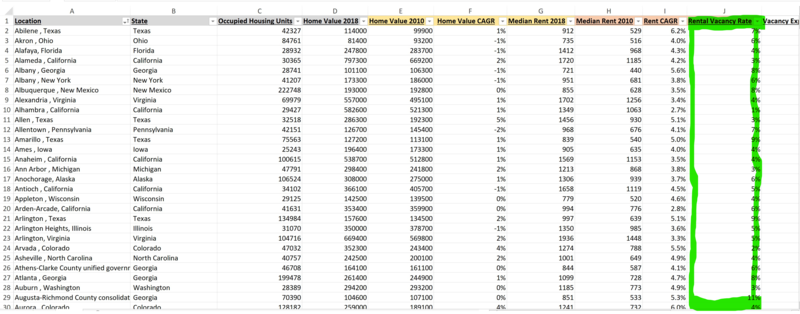
    Why bother with the poll when the data is right here! 

    You can make a good first approximation about each town and answer all your questions. You can even model out best and worse case scenarios to see what level of vacancy turns people cash flow negative in different areas. 

  • Joe VilleneuvePro Member
    Plymouth, MI · Member since 2013 · 13k+ posts · 19k+ votes
    6y
    Originally posted by @Bill F.:
    Originally posted by @Joe Villeneuve:

    I thought about this last night.  Here is a poll I would like to take regarding the security and returns from cash flow properties over the last 5 years.  

    The question is simple and in 3 parts:  Over the last five years, adding up all of your "doors", a)- how many months of vacancy did you have, and b) how many months of income (cf) did you have, and c) - did the other rental income (CF) cover the vacancies?

    Example: An investor had 100 doors (mix of multi and sf). Over the past 5 years, the REI averaged 10 vacancies/month. The answer to my 3 part question would then be -
    a) - 10 vacancies/mo x 12 months x 5 years = 600 vacancies
    b) - 90 non-V/mo x 12 mo x  5 years = 5400 NV
    c) - Yes (if no)

    In order to participate, you must have had at least 5 doors avg/year over the last 5 years.

    Why bother with the poll when the data is right here! 

    You can make a good first approximation about each town and answer all your questions. You can even model out best and worse case scenarios to see what level of vacancy turns people cash flow negative in different areas. 

     I'm taking the poll to see what those who are on this forum say...not what the totals and averages are for a list of major cities...which means nothing to me.  Every major city is so large that it has a number of different micro markets in them.  These micro markets have numbers that are at both extremes and are what make up the average...which isn't a true representation of an investment area.  You can invest in one of the "ideal" cities based on the data above...and lose money every month, and you can invest in that same city and make well over the average.

  • Investor · Boston, MA · Member since 2015 · 1k+ posts · 3k+ votes
    6y
    Originally posted by @Joe Villeneuve:
    Originally posted by @Bill F.:
    Originally posted by @Joe Villeneuve:

    I thought about this last night.  Here is a poll I would like to take regarding the security and returns from cash flow properties over the last 5 years.  

    The question is simple and in 3 parts:  Over the last five years, adding up all of your "doors", a)- how many months of vacancy did you have, and b) how many months of income (cf) did you have, and c) - did the other rental income (CF) cover the vacancies?

    Example: An investor had 100 doors (mix of multi and sf). Over the past 5 years, the REI averaged 10 vacancies/month. The answer to my 3 part question would then be -
    a) - 10 vacancies/mo x 12 months x 5 years = 600 vacancies
    b) - 90 non-V/mo x 12 mo x  5 years = 5400 NV
    c) - Yes (if no)

    In order to participate, you must have had at least 5 doors avg/year over the last 5 years.

    Why bother with the poll when the data is right here! 

    You can make a good first approximation about each town and answer all your questions. You can even model out best and worse case scenarios to see what level of vacancy turns people cash flow negative in different areas. 

     I'm taking the poll to see what those who are on this forum say...not what the totals and averages are for a list of major cities...which means nothing to me.  Every major city is so large that it has a number of different micro markets in them.  These micro markets have numbers that are at both extremes and are what make up the average...which isn't a true representation of an investment area.  You can invest in one of the "ideal" cities based on the data above...and lose money every month, and you can invest in that same city and make well over the average.

    Suit yourself Joe, you asked a question so I thought I'd try and help you out. Didn't know you wanted to get that granular. 

    My mistake, won't happen again.  

    For what its worth, the data set has 552 cities and the cutoff if 25,000 occupied housing units, so it goes way beyond major cities. 

    Happy polling!


Join the conversationCreate a free account to reply, vote on answers and follow this thread.